FAQ Schema in Fintech After 2023: The YMYL Reframe Most Compliance Teams Missed

YMYL (Your Money, Your Life) content lives or dies on trust signals. For two years, FAQ schema was one of the easiest signals a fintech site could ship: visible question-answer pairs in the SERP, validating that the brand answered the questions a regulator-conscious buyer would ask. Google retired that visual treatment in August 2023. The schema still validates. The trust signal still matters. The path it travels is now different, and most fintech compliance teams never updated the playbook.
What changed and when

Google announced the FAQ rich results retirement on August 8, 2023. The narrowing was severe: only authoritative government and medical institution sites kept the visual SERP treatment. Search Engine Land confirmed that fintech, even regulated fintech, did not make the exception list. Banking, insurance, lending, payments, crypto, robo-advisory all lost the FAQ dropdown.
For fintech specifically, the irony was sharp. The same regulatory framing that pushed fintech sites to publish exhaustive FAQ pages (disclosure obligations, consumer-protection norms, plain-language requirements) also made FAQ schema feel like a natural fit. Then Google decided commercial fintech was not authoritative enough to keep the visual reward.
Why this hits fintech harder than the average commercial niche
Three structural reasons.
1. Fintech SERPs are dominated by aggregators and regulators. A search like “best high-yield savings account 2026” returns NerdWallet, Bankrate, the FDIC, ConsumerFinance.gov, and a few major banks. A challenger fintech sits at position 8 or 12. FAQ rich results were one of the few SERP features that let a single fintech brand expand vertical real estate enough to surface above the regulator-listed pages without paying for placement.
2. YMYL E-E-A-T scrutiny is highest in fintech. Google’s quality rater guidelines treat financial pages as YMYL and apply a stricter trust threshold than most niches face. FAQ schema was a structured way to show, to both Google and a buyer scanning the SERP, that the page proactively answered the regulator-style questions a fintech buyer was about to ask. Losing the visual treatment did not make those answers less important. It just stopped them from appearing in the SERP.
3. Compliance review cycles slow content updates. A SaaS marketing team can ship a content change in a day. A fintech marketing team often runs every word change past compliance, legal, and sometimes a regulator. In our experience working with fintech founders between Series A and Series C, this is the primary reason fintech site copy lags trends by 12 to 18 months. The FAQ retirement was a 2023 event. We are still finding fintech pricing and disclosure pages in 2026 that explicitly cite “FAQ schema for rich results” as part of their published SEO strategy.
What fintech sites should change
1. Keep FAQ schema, but reframe its purpose internally
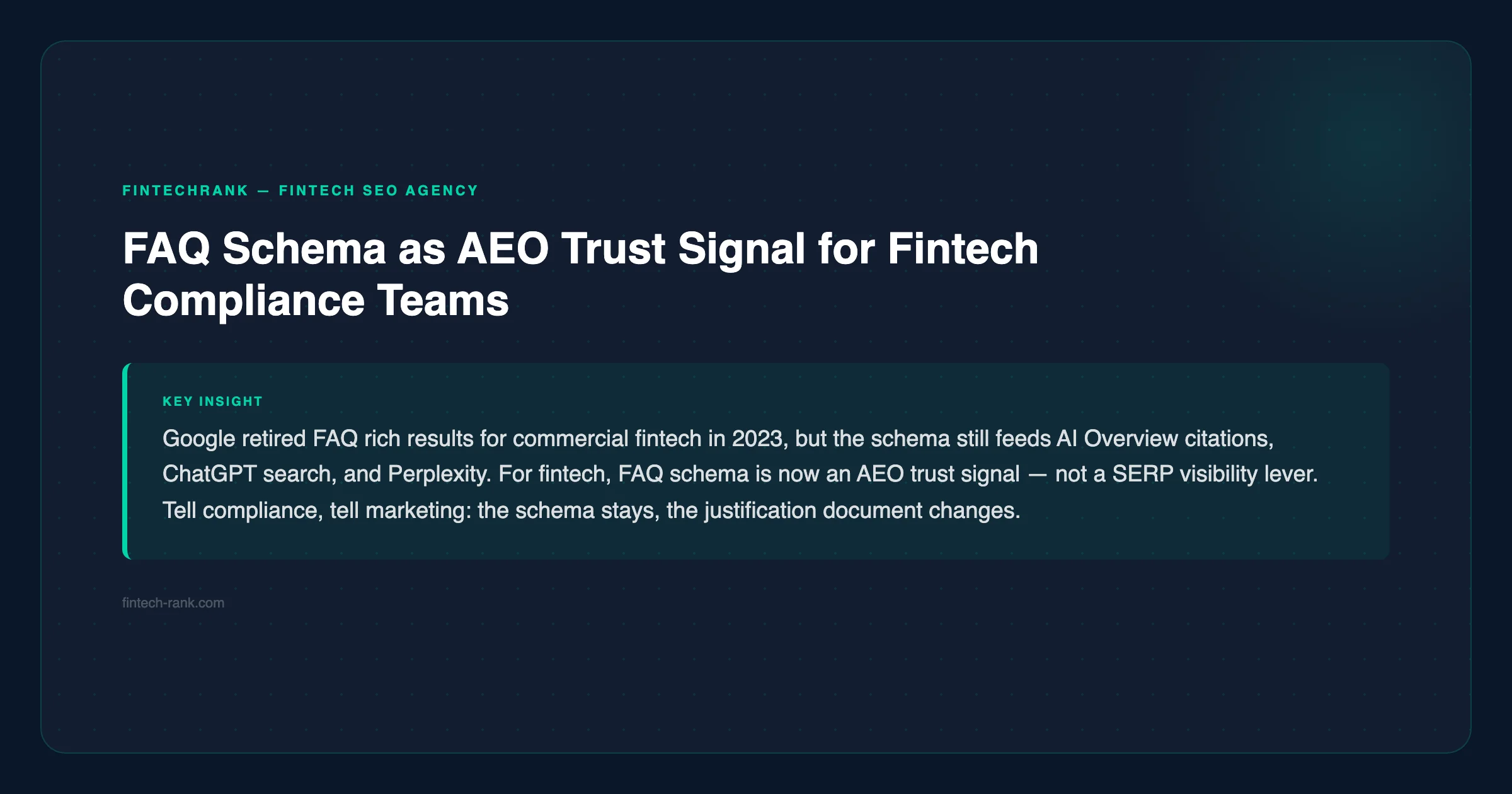
The schema still feeds AI Overview citations, ChatGPT search, and Perplexity. For fintech research-phase queries (“what is APR”, “is a HYSA FDIC insured”, “how does crypto staking get taxed”), citation in an AI answer is the highest-trust placement available, often higher than a blue-link click. FAQ schema is now an AEO trust signal, not a SERP visibility lever. Tell compliance, tell marketing, tell engineering. The schema stays. The justification document changes.
2. Invest the engineering effort that was sitting on FAQ schema into Organization, FinancialService, and BreadcrumbList
For fintech specifically, the schema types that still drive SERP outcomes are:
| Schema | What it does in 2026 | Fintech use case |
|---|---|---|
| Organization | Knowledge Panel on branded search, AI source attribution | Site-wide, with regulatory licenses listed in identifier |
| FinancialService | Service description in SERP, AI Overview source eligibility | Per product line (lending, savings, insurance) |
| Service | Pricing and service-area features | Per product page |
| BreadcrumbList | Clean SERP path | All pages |
| Article | Top Stories eligibility for fintech news content | Blog and pillar content |
The compounding move is FinancialService schema with regulatory identifier fields populated correctly. Most fintech sites we audit list licenses in footer text but never in machine-readable schema. The licenses are public. The regulators publish them. Adding them to FinancialService schema is a one-time setup that reinforces YMYL E-E-A-T for both Google’s quality systems and AI Overview source ranking.
We covered the YMYL pattern in depth in our breakdown of YMYL SEO for fintech and in the fintech SEO compliance playbook. FAQ schema reallocation is one of several updates fintech sites have not made since 2023.
3. Restructure FAQ-heavy pages around AI Overview citation criteria
The page-structure rule for getting cited in AI Overviews is different from the structure that won FAQ rich results. AI systems extract from passages with these properties:
- Direct definitional answer in the first sentence under each subheading
- 30-50 word answer length (longer answers do not get cited; shorter look thin)
- One specific number, threshold, or named entity per answer
- Source links to underlying regulatory or authoritative reference
That is not “Yoast added schema.” That is content rewriting. For a regulated fintech disclosure page, this work needs compliance review, but the rewrite is small, paragraph-by-paragraph, and pays off on the searches AI Overviews are eating into.
If your fintech SEO strategy still treats FAQ schema as a SERP investment rather than an AEO trust signal, this is the gap. We work through this from end-to-end in the FinTechRank pillar guide.
If you want a structured audit of where your fintech site is signaling trust into a SERP feature Google retired three years ago, that is the first deliverable in every FinTechRank engagement.
FAQ
Does fintech qualify for the FAQ rich result exception? No. The exception is limited to authoritative government and medical institution sites. Even regulated fintech under FinCEN, FCA, MAS, or equivalent does not qualify. Domain authority does not change this. Google made the call on entity type, not signal strength.
Should we remove FAQ schema from disclosure pages? No. Disclosure pages benefit from FAQ schema for AI Overview citation, where buyers increasingly research regulatory questions. The schema also reinforces YMYL E-E-A-T signals to Google’s quality systems. Compliance has no reason to require removal.
What schema should replace FAQ as our primary SEO investment?
For fintech, FinancialService schema with populated identifier fields for regulatory licenses, plus Organization schema sitewide. These produce SERP features that are still active in 2026 and reinforce YMYL trust signals AI Overviews use to pick sources.