YMYL SEO for Fintech: How Google Decides Whether to Trust Your Content

Two fintech sites publish the same article on the same day. Same word count, same keyword target, same on-page setup. One ranks on page two within six weeks. The other stays in positions 80 to 100 for months.
The difference is rarely the SEO. It is the trust layer Google built specifically for content like yours.
That layer has a name: YMYL. Your Money or Your Life. If you run a fintech, almost every page on your site falls inside it, and the rules are different from what most SEO guides describe.
This post is what every fintech founder should read before writing another piece of content.
What YMYL Actually Means

YMYL is Google’s internal label for content that could affect a reader’s financial wellbeing, health, safety, or major life decisions. It comes from the Search Quality Rater Guidelines, a 170-page document Google uses to train the human reviewers who score search results.
For fintech, the classification is almost universal. Pages on payments, lending, investments, insurance, neobanking, regtech, and personal finance all sit inside YMYL. Even a product comparison page on your own site qualifies if it influences how someone spends or moves money.
What changes inside YMYL is the trust bar. Outside YMYL, a thin or anonymous post can still rank if the SEO is clean and the topic is unsaturated. Inside YMYL, that page caps out around position 30. The technical work gets you indexed. The trust signals decide where you land.
If you have not yet run a fintech SEO audit checklist against your top pages, that is the fastest way to surface where the trust layer is missing.
How E-E-A-T Translates Into Real Page Elements
E-E-A-T is the framework Google uses to score YMYL trust: Experience, Expertise, Authoritativeness, Trustworthiness. The acronym sounds abstract. The page elements are concrete.
Author bylines with names. No “by the team” or “by admin.” Every YMYL page needs a named author. Add a small bio block under the byline. Photo, two sentences on relevant experience, link to LinkedIn.
Credentials that match the topic. A lending compliance article written by an unnamed staff writer fails the bar. The same article written by a named author with five years at a regulated lender passes. Match the credential to the topic.
Review dates. Show when the page was last reviewed, not just when it was first published. For YMYL content, freshness signals editorial care. A page reviewed in the last 12 months reads as actively maintained.
Primary source citations. Any factual claim or statistic gets linked to its original source. Not Wikipedia, not a roundup post. The original report, regulator filing, or named research. This single change moves more pages off the bottom of YMYL search than any other on-page edit.
Organization and Person schema. Tell Google who you are in structured data. Organization schema on the homepage. Person schema on author pages, with sameAs to LinkedIn and any verified profile. This is how the trust signals get parsed at scale.
These signals are also covered as part of the ranking factors that matter for fintech companies, specifically why Google evaluates fintech sites against a stricter standard than other industries.
The Three YMYL Patterns That Cap Fintech Rankings
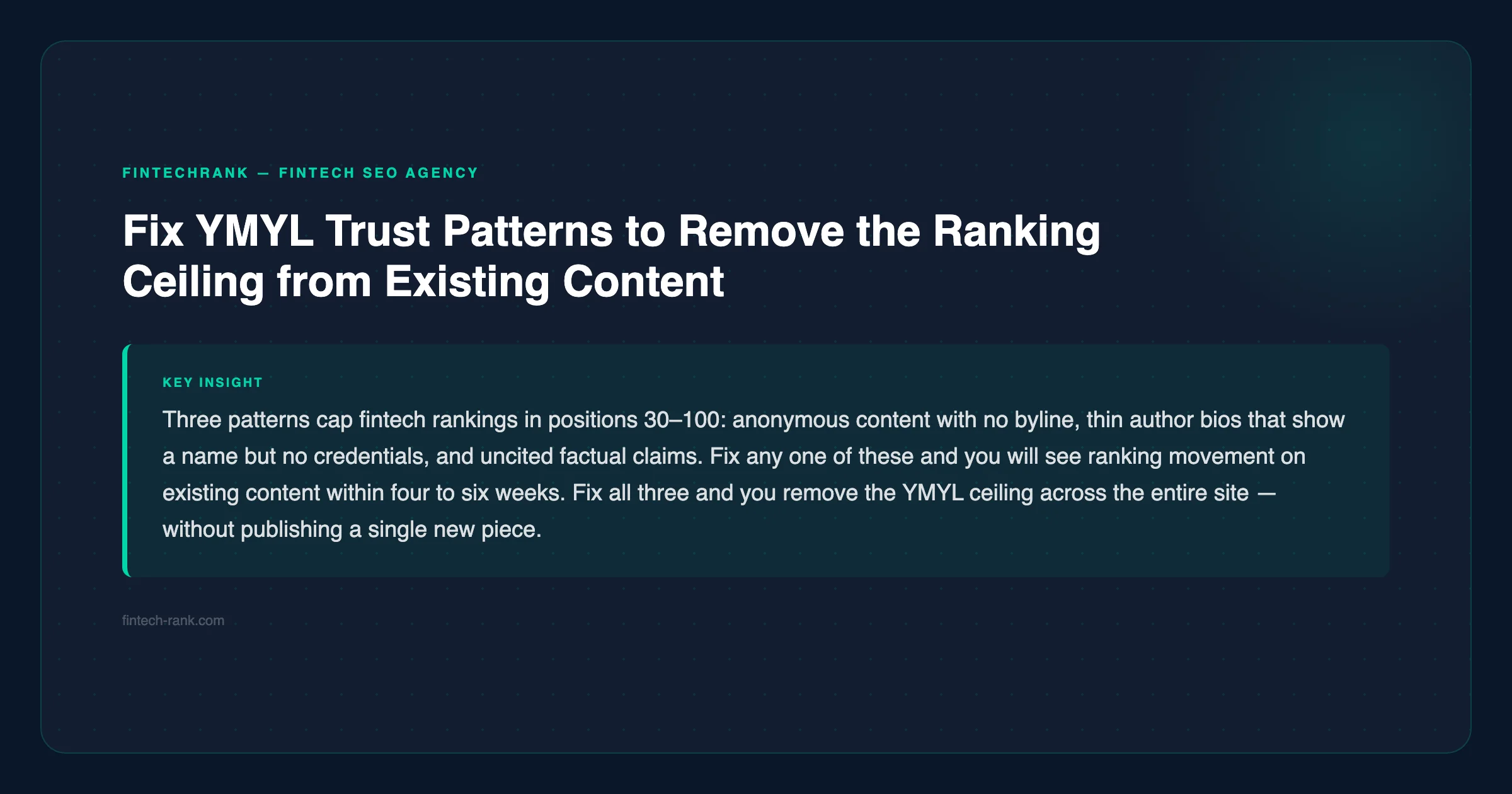
In every fintech audit we run, three patterns explain most of the underperformance.
Pattern one: anonymous content. Posts published with no byline or under a generic “Editorial Team” credit. The pages get indexed. They never break into the top 20 because there is no person attached to the expertise claim.
Pattern two: thin author bios. A name on the byline but no bio. Or a bio that says “Sarah loves writing about fintech” and lists no credentials. For Google’s quality raters, that is not a credential, it is a tagline. The page reads as marketing, not expertise.
Pattern three: uncited claims. A blog post that says “fintech CAC averages $200” with no link to a source. In YMYL, every numeric or factual claim needs a citation. Without it, the page reads as opinion. Opinion content does not rank for commercial fintech queries.
Fix any one of these three and you will see ranking movement within four to six weeks on existing content. Fix all three and you remove the YMYL ceiling on the entire site.
What This Means for Your Content Plan
If you are building a fintech content cluster, sequence the trust work before the volume work.
Start with author pages. Every named contributor gets a bio page with credentials, photo, LinkedIn link, and Person schema. This is one-time setup work that lifts every future post.
Then add review dates and a documented review process. Even a single line “Last reviewed: April 2026 by [Name], [Role]” tells Google the page is maintained.
Only then start publishing volume. Twelve trust-signalled posts beat fifty anonymous ones in YMYL every time.
For the broader strategy this fits into, our fintech SEO strategy for startups post covers the 90-day plan that puts trust signals before volume.
When to Bring in Help
YMYL is solvable in-house if you have one editor with the time to enforce the standard across every published piece. Where it usually breaks down: when content production competes with product marketing and demand gen, the trust layer is the first thing dropped.
That is the gap FinTechRank closes. We write fintech content with E-E-A-T baked in from the first draft, run the compliance review alongside the SEO review, and ship pages that pass both Google’s trust bar and your legal team’s. Start with a fintech SEO audit if you want to see where your YMYL signals stand today.
FAQ
What does YMYL mean for fintech SEO?
YMYL stands for Your Money or Your Life. It is a Google classification for content that could affect a reader’s financial wellbeing, health, safety, or major life decisions. Almost every fintech page falls under YMYL. The classification means Google holds your content to a higher trust bar. Author credentials, factual citations, and review processes weigh more than they do for non-YMYL content.
How do I prove E-E-A-T in fintech content?
Name your authors. Show their credentials. Add review dates. Cite primary sources for any factual or numerical claim. Add Organization and Person schema. Link author bios to LinkedIn profiles that confirm the experience claimed. Google’s quality raters check all of this manually for YMYL content. Skipping any of it caps your ranking ceiling.
Can a small fintech rank in YMYL categories?
Yes, but not on the same keywords as Bankrate or Nerdwallet. Small fintechs win on long-tail product-specific queries where the larger publishers have not invested. A bootstrapped fintech can rank for embedded payments compliance or B2B lending KYC requirements. It will not outrank a national publisher on credit cards. Pick the right targets.
Camilla Gleditsch is the founder of FinTechRank, a fintech-specialised SEO operation for early-stage US fintech companies. Connect on LinkedIn.