SEO Compliance for Financial Services: How to Ship Content Legal Will Actually Approve

A fintech founder we spoke with last quarter had a clear pattern. Every new blog post sat in legal review for three weeks. Half came back redlined so heavily the content team rewrote them from scratch. The other half shipped, ranked nowhere, and quietly disappeared from the editorial calendar.
The diagnosis was not a slow legal team. The drafts arrived in review with the wrong language, missing disclosures, and claims that no compliance reviewer in any regulated industry would have signed off. Three weeks of redlining was the outcome of writing content that ignored the regulatory standard, not a sign of dysfunction in the review process.
This post is how to fix that upstream. The patterns below are the ones that get fintech drafts approved on the first pass and ranking inside three months.
Why SEO and Compliance Conflict

Most SEO advice was written for industries where the content can claim almost anything. Best, fastest, lowest, free. Generalist SEO teams reach for those words because they convert. In financial services, every one of them is a redline.
The result is a workflow where the SEO team writes for clicks, the legal team writes for risk, and the page bounces between them for weeks. By the time it ships, the keyword window has moved and the content reads as committee-edited.
The fix is upstream. Brief the writer on the regulatory standard at the same time as the keyword target. The two are not in conflict if the writer knows both rules from the first sentence.
Our YMYL SEO for fintech post covers why this matters from Google’s side. This post covers it from your legal team’s side.
The Three Language Patterns That Trigger Redlines
1. Superlatives and Guarantees
“The best fintech SEO agency.” “Guaranteed compliance.” “The fastest payments processor.” Every word in those phrases is a flag. Superlatives need substantiation. Guarantees in financial services are nearly always over-claims.
The fix is structural. Replace the superlative with a specific, attributable claim. “We rank the average client in the top 30 within 90 days” is testable. “We are the best agency for fintech” is not. Specificity reads stronger to buyers and passes legal in one pass.
2. Comparative Claims Without Sourcing
“Faster than legacy banks.” “Lower fees than Stripe.” “Better security than competitors.” Comparative claims require citations or get rewritten in review every time.
The fix is to cite or qualify. “Our settlement time averages T+0 versus the industry standard T+1, per [named source]” is defensible. “Faster than competitors” is not. If the data does not exist publicly, qualify the claim instead. “Designed for faster settlement than legacy infrastructure” is a positioning statement, not a comparative claim, and it ships.
3. Statistics Without Citation
“Fintech CAC averages $200.” “70% of consumers prefer mobile-first banking.” “SEO drives 53% of website traffic.” These read as data but they are unsourced assertions. In YMYL content, that is both a Google trust signal failure and a legal redline.
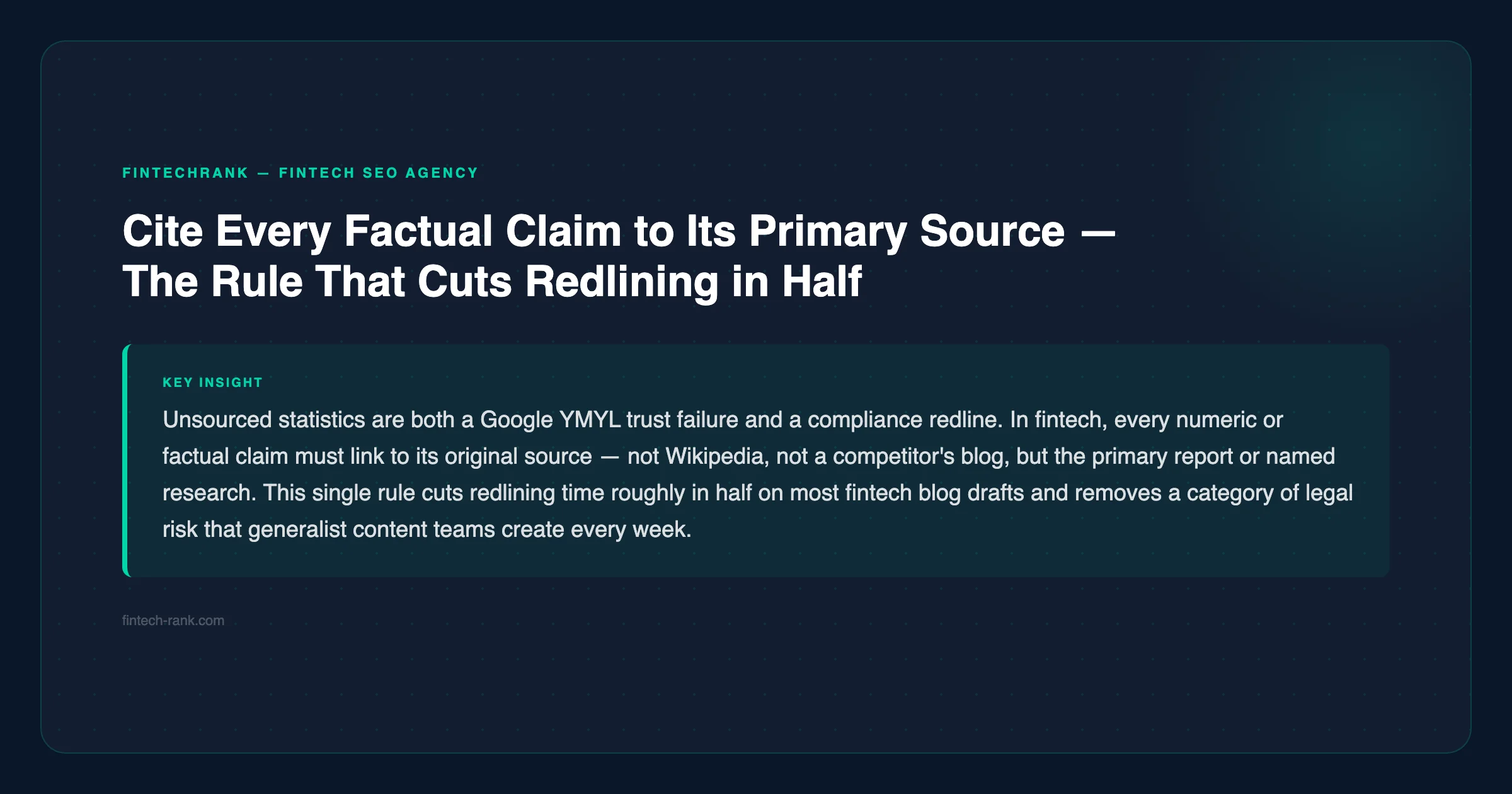
The fix is non-negotiable. Every numeric or factual claim links to its primary source. Not Wikipedia, not a competitor’s blog, not a roundup. The original report or named research. This single rule cuts redlining time roughly in half on most fintech blogs.
What Compliance-Aware Drafts Look Like
A draft that passes both SEO and compliance review on first pass usually has six properties.
Disclosures present and visible. Any page making rate, return, or product claims includes the relevant disclosure block. Above the fold or one scroll down, not in the footer. Treat disclosures as part of the page design, not as an afterthought.
Claim language qualified. No guarantees, no unbacked superlatives, no comparative claims without citation. The writing reads more measured than typical marketing copy, which is the point.
Author credentials match the topic. A piece on lending compliance written by an unnamed staff writer fails both the YMYL bar and the legal review. The same piece written by a named author with relevant background passes both.
Citations on every factual claim. Statistics linked to original sources. Regulatory references linked to the regulator’s actual page, not a third-party explainer.
Review process documented. The page shows the date last reviewed and, ideally, the reviewer. This is one line of HTML and it satisfies both Google’s quality raters and your audit trail.
Disclaimers calibrated to the content type. Educational content has different disclaimer requirements than product content. Product pages with rate or return claims have stricter requirements than thought leadership. Match the disclaimer to the page intent.
If you have not yet diagnosed where your existing pages stand on these six properties, the fintech SEO audit checklist covers compliance signals as items 24 to 27.
How to Build the Workflow
The mechanical steps that cut compliance review time from three weeks to three business days.
Step one. Brief writers on the regulatory standard before the keyword target. A two-page internal document covering disclosure rules, prohibited claim language, and citation expectations. Every freelancer or in-house writer reads this before their first piece.
Step two. Add a compliance pre-check to the editorial workflow. Before the draft enters legal review, a content team member runs a checklist against the language patterns above. Most redlines die at this stage.
Step three. Centralise approved phrasing. Maintain a short library of pre-approved language for common claims your team writes about repeatedly. New drafts pull from the library instead of generating new phrasing each time.
Step four. Set a service level on legal review. Three business days per piece if the draft hits the compliance pre-check. The faster turnaround happens because the redlines are minor, not because the legal team rushed.
Done together, these four steps move fintech content from “publishes once a month” to “publishes twice a week.” The SEO compounds from there.
For the broader strategy this fits into, see our fintech SEO strategy post.
When to Bring in a Specialist
If your team is publishing one piece a month and three of them are stuck in legal review at any time, the workflow above closes that gap in-house. It takes one editor with the time and authority to enforce the standard.
If your team does not have that bandwidth, that is the gap FinTechRank closes. We write fintech content with the compliance standard baked into the first draft, run our own pre-check before delivery, and ship pages that pass legal review in days, not weeks. Start with a fintech SEO audit if you want to see where your current content stands against this standard.
FAQ
Why does compliance review slow down fintech SEO?
Most generalist agencies write fintech content the same way they write content for ecommerce or SaaS. The drafts include claim language, comparative phrasing, and unbacked statistics that legal teams have to redline page by page. The bottleneck is not the review itself. It is the gap between how the content was written and what the regulatory standard requires. Closing that gap at draft time eliminates most of the friction.
What language patterns trigger compliance redlines in fintech?
Three patterns trigger most redlines. First, guarantees and superlatives (best, fastest, lowest, guaranteed). Second, comparative claims without sourcing (we beat competitors). Third, financial statistics without citation. Replace each pattern with cited, qualified, or attributed phrasing and the redline rate drops to near zero.
Can SEO and compliance work in the same workflow?
Yes, when the content team understands the regulatory standard upfront. The two functions only conflict when SEO is treated as a separate process from compliance. When the writer is briefed on disclosure rules, claim language, and YMYL requirements at the same time as keywords and search intent, both standards are met in one draft.
Camilla Gleditsch is the founder of FinTechRank, a fintech-specialised SEO operation for early-stage US fintech companies. Connect on LinkedIn.