Fintech Keyword Research: How to Find the Keywords You Can Actually Rank For

Most fintech companies waste their first six months of SEO targeting keywords they will never rank for. “Payment processing,” “digital banking,” “investment platform” - these terms look like obvious targets. They are. That is the problem. Stripe, PayPal, NerdWallet, and Bankrate have been building authority on those keywords for over a decade. A Series A fintech competing head-to-head is not running a race. It is running into a wall.
This guide covers a fintech keyword research framework built specifically for early-stage companies. You will learn the five keyword categories that actually produce results, how to set KD thresholds that match your domain authority, and how to build a keyword master list you can act on immediately. If you are building your fintech SEO strategy from scratch, keyword research is where it starts.
What Is Fintech Keyword Research?

Fintech keyword research is the process of identifying search terms that potential buyers use when looking for financial technology products or services, then prioritizing those terms by search intent, keyword difficulty, and business relevance. For early-stage fintech companies, the goal is finding high-intent terms with low competition, typically KD under 20, rather than chasing high-volume terms owned by established financial brands.
Why Standard Keyword Research Breaks for Fintech
Generic keyword research tools give you a list of terms sorted by volume. That approach works fine for an e-commerce store. For fintech, it surfaces the wrong targets every time.
Three structural problems make fintech different:
Brand dominance at the top. The highest-volume fintech keywords - “credit card,” “money transfer,” “trading app” - are owned by companies with domain ratings above 80. Ahrefs’ keyword difficulty methodology factors in the quality and quantity of backlinks on the first page. For these terms, you need thousands of referring domains just to compete. No early-stage fintech has that on day one.
YMYL clustering. Google’s “Your Money or Your Life” classification applies to most fintech content. Financial advice, investment information, and payment processing content get scrutinized more carefully. Generic, thin content does not rank. This means competing requires genuine depth and demonstrable expertise, which is an advantage for specialized companies, but it also narrows the viable keyword pool.
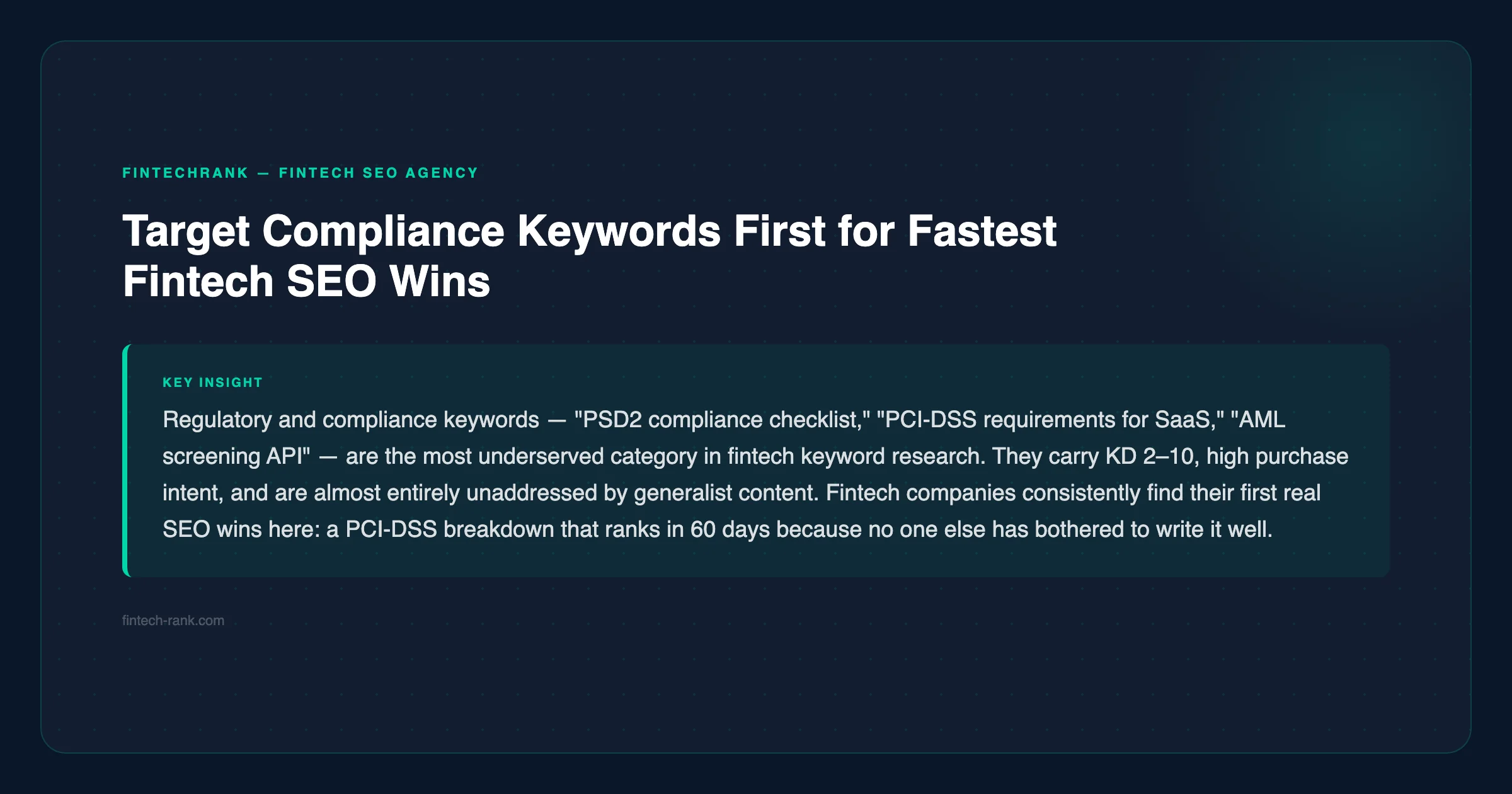
Compliance terminology as keyword opportunity. This is the part competitors miss. Regulatory and compliance terms like “PSD2 compliance checklist,” “PCI-DSS requirements for SaaS,” “AML screening API” are low-competition, high-intent, and almost entirely unaddressed by generalist SEO content. The companies that will buy from you search for these terms constantly.
The 5 Fintech Keyword Categories
Instead of keyword research by volume, organize your research by category. Each category serves a different buyer stage and carries different ranking dynamics.
1. Product and Feature Keywords
These are searches for specific capabilities your product offers. They signal buying intent but are often narrower than you think.
- “embedded finance API for SaaS” (est. KD 6-10)
- “white label payment processing” (est. KD 15-22)
- “real-time payments API” (est. KD 12-18)
- “open banking API integration” (est. KD 8-14)
These keywords are mid-funnel. Buyers searching for a specific API or feature integration are comparing vendors. Your content here should be technical, specific, and show the product in context.
2. Problem and Pain Keywords
Buyers do not always know the name of the solution they need. They search for the problem first.
- “how to reduce payment fraud for marketplaces” (est. KD 3-8)
- “why is my transaction decline rate so high” (est. KD 2-5)
- “how to speed up KYC onboarding” (est. KD 4-9)
- “payment processing fees eating into margins” (est. KD 2-6)
These keywords are top-of-funnel and almost entirely uncontested. The buyer is early in their research. Your job is to explain the problem clearly, demonstrate that you understand it, and introduce your product as a relevant solution without a hard sell.
3. Comparison Keywords
When a buyer is close to a decision, they compare options. Comparison keywords have commercial intent and convert well.
- “Stripe vs Braintree for marketplaces” (est. KD 5-12)
- “Plaid alternatives for personal finance apps” (est. KD 6-10)
- “Adyen vs Stripe for enterprise” (est. KD 8-15)
You do not need to be one of the compared brands to rank for these terms. A well-structured comparison article - objective, data-backed, covering the relevant tradeoffs - can rank for comparison searches and introduce your product as an alternative at the end.
4. Regulatory and Compliance Keywords
This is the most underserved keyword category in fintech. Compliance requirements create constant search demand, and almost no one is producing content that properly addresses them.
- “PSD2 compliance checklist for payment providers” (est. KD 2-6)
- “DORA compliance requirements for fintech” (est. KD 3-7)
- “PCI-DSS SAQ types explained” (est. KD 4-8)
- “AML transaction monitoring requirements” (est. KD 5-10)
These buyers are often in-house legal, compliance, or engineering teams - not just marketing. If your product touches any of these compliance areas, content here builds authority and generates qualified inbound traffic that no other type of content reaches. This is where fintech companies consistently find their first real SEO wins: a compliance glossary page or a PCI-DSS breakdown that ranks in 60 days because no one else has bothered to write it well.
5. Educational and Awareness Keywords
Top-of-funnel, informational content for buyers in the early research phase.
- “what is embedded finance” (est. KD 8-18)
- “how does open banking work” (est. KD 10-20)
- “what is a payment orchestration platform” (est. KD 3-8)
- “difference between acquirer and payment processor” (est. KD 2-5)
These keywords build awareness and long-term authority. They are also where AI search (ChatGPT, Perplexity, Google AI Overviews) pulls heavily, making them important for AEO as well as traditional rankings.
KD Thresholds for Early-Stage Fintech Companies
Keyword difficulty is not a fixed number you memorize. It is a ceiling that shifts as your domain authority grows. Here is a working framework:
| Stage | Domain Rating | Primary target KD | Cluster content KD |
|---|---|---|---|
| Pre-launch / new domain | 0-10 | Under 10 | Under 20 |
| Early SEO (6-12 months) | 10-25 | Under 20 | Under 30 |
| Established (12-24 months) | 25-40 | Under 30 | Under 40 |
| Competitive | 40+ | Under 40 | Under 50 |
These are working guidelines, not hard rules. A KD 25 keyword with zero quality content on the first page may be more achievable than a KD 12 with strong coverage. Always check the actual SERP, not just the number.
For companies starting their fintech SEO strategy guide, the priority is landing one clear primary keyword per page under KD 20. This is also the right foundation before you think about keyword research before you start paid ads: paid campaigns cost less when organic content already validates demand.
How to Find Keyword Gaps with Ahrefs or Semrush
The fastest way to find keywords your competitors are not covering is a competitor content gap analysis. Here is a repeatable process:
Step 1: List 3-5 direct competitors. These should be companies targeting the same buyer, not the Stripes and PayPals of the world.
Step 2: Run a content gap in Ahrefs. Go to Site Explorer, Content Gap, enter your competitors’ domains. Filter by keywords they rank for (positions 1-20) that you do not. This surfaces everything they are covering that you are missing.
Step 3: Filter by KD. Set the KD ceiling to 20. Remove navigational queries (brand names, “login,” “pricing”). What remains is your opportunity list.
Step 4: Cross-reference with intent. Apply the five categories above. Compliance and problem keywords in this list are your highest-priority targets. They are often the easiest to rank for and the closest to purchase intent.
Semrush’s intent classification methodology is useful here for tagging each keyword as informational, navigational, commercial, or transactional before you build content. Matching content type to intent is one of the most reliable ways to improve page-level performance.
Intent Mapping: Matching Keywords to Funnel Stage
Not every keyword deserves the same content format. Matching intent to format improves rankings and conversion.
| Keyword intent | Content format | Example |
|---|---|---|
| Informational | Guide, explainer, glossary | ”What is a payment facilitator?” |
| Commercial investigation | Comparison, case study, review | ”Stripe vs Adyen for platforms” |
| Transactional | Service page, landing page | ”Embedded finance API for SaaS companies” |
| Regulatory/compliance | Checklist, detailed guide | ”PCI-DSS compliance for SaaS: What you need to know” |
A page targeting a transactional keyword should read like a service page - specific, outcome-focused, with a clear CTA. A page targeting an informational keyword should be comprehensive and educational. Mixing these up is one of the most common reasons well-researched keyword lists do not produce results.
Building Your Keyword Master List
Structure your master list with these columns:
- Keyword - exact search term
- Monthly volume - from Ahrefs / Semrush / Google Keyword Planner
- KD - keyword difficulty score
- Intent - informational / commercial / transactional / compliance
- Category - one of the five types above
- Funnel stage - top / mid / bottom
- Target page - which page on your site will target this keyword
- Priority - high / medium / low (based on KD ceiling and business relevance)
Start with 30-50 keywords. You do not need 500 terms to build a content plan. You need 10-15 solid primary targets and 30-40 supporting cluster keywords.
FAQ
What KD should a fintech startup target?
For a new domain with no established authority, target primary keywords under KD 10 for the first three to six months. Compliance, regulatory, and problem-based keywords often fall in this range. Once you have 20-30 pieces of indexed content and some backlinks, you can target up to KD 20 for primary pages. Cluster content can go up to KD 30-35.
How do you find keywords your competitors are not ranking for?
Run a content gap analysis in Ahrefs or Semrush using three to five direct competitors. Filter results by KD under 20 and remove navigational queries. What remains is content your competitors have not produced - those are your fastest opportunities. Compliance keywords in particular are often completely unaddressed.
What is the difference between informational and commercial keywords in fintech?
Informational keywords indicate a buyer in research mode: “how does open banking work,” “what is PCI-DSS.” They want to understand something, not buy yet. Commercial keywords signal a buyer comparing options or evaluating vendors: “best embedded finance API,” “Plaid vs Finicity.” Both matter, but commercial keywords are closer to revenue and deserve service pages or comparison content, not general blog posts.
Ready to build your fintech keyword strategy?
If you want to see exactly which keywords your company can rank for, download the Fintech SEO Blueprint for a step-by-step guide, or get in touch to discuss what we would do for your business.