SEO vs Paid Ads for Fintech Companies: A Budget Decision Framework

For most Series A-C fintech companies, paid search alone is a losing equation. Financial services CPCs range from $15 to $50+ per click. At 2-3% conversion rates, customer acquisition costs hit $500-$2,500 per lead before you factor in sales cycles. SEO delivers compounding returns at a fraction of that cost over a 12-month horizon. The right move for most fintechs is not “SEO or paid.” It is using paid tactically while building organic as your long-term engine.
You have been running Google Ads. Maybe LinkedIn too. The leads come in, the budget goes out, and every month you are back at zero - same spend required to hit the same number. Your Head of Finance is asking why the CAC keeps climbing. Your paid specialist says CPCs in financial services are just expensive.
They are not wrong. But there is another option you may not have fully modelled yet.
This post breaks down the actual maths of SEO vs paid ads for fintech companies, when each channel makes sense, and how to make the case to your CFO.
The Fintech Paid Ads Problem

Financial services is one of the most expensive categories in Google Ads. According to WordStream’s industry benchmarks, financial services advertisers pay an average CPC of $3.44 - but that average is dragged down by insurance and mortgage products with high search volume. Fintech-specific terms (“embedded lending platform,” “fintech compliance software,” “payment orchestration”) regularly hit $15-$50 per click, with some compliance and RegTech terms pushing past $80.
The math plays out like this:
- 500 clicks/month at $25 average CPC = $12,500/month
- At 3% conversion to lead = 15 leads
- At 20% close rate = 3 customers
- CAC = $4,167 per customer from paid search alone
That is before your SDR time, demos, and contract cycles. For a Series B fintech selling a $2,000/month SaaS product, you need 2+ months just to break even on acquisition cost.
There is also a compounding disadvantage: the moment you stop paying, the leads stop. Paid is renting visibility. SEO is owning it.
The Maths: $100k Budget at Month 6 and Month 12
Assume a $100k annual marketing budget. Here is how the two channels compare in deployment:
Paid-only allocation ($100k into Google Ads)
- Monthly budget: ~$8,300
- At $25 average CPC: ~332 clicks/month
- At 3% conversion: ~10 leads/month
- At 12 months: ~120 leads total
- Stop spending: leads drop to zero on day one of month 13
SEO-first allocation ($100k - $60k into SEO, $40k into paid)
- Months 1-3: SEO investment building (content cluster, technical work, early rankings)
- Month 4-6: First rankings appear. Organic traffic begins. Paid still running at lower budget.
- Month 12: Organic delivers 40-80 leads/month on its own. Paid contributes another 15-20.
- Stop SEO spending: rankings persist. Traffic continues. Leads continue.
According to First Page Sage’s organic SEO ROI research, B2B companies see an average return of $22 for every $1 spent on SEO over a 3-year horizon, significantly above paid search ROI in competitive verticals.
The compounding effect is the key difference. SEO builds an asset. Paid builds a dependency.
Why Organic Converts Better in Fintech
Trust is not a soft variable in financial technology. It is a purchase condition.
A VP of Finance at a mid-market company researching “embedded lending platforms” is not clicking an ad and signing a contract. They are reading. They are checking credibility signals. They are seeing whether the company knows its subject matter.
HubSpot’s research puts organic search close rates at 14.6% compared to 1.7% for outbound. The gap exists because organic traffic arrives pre-qualified - they searched the exact problem your product solves, found your content, read it, and decided you knew what you were talking about before the first conversation.
Paid ads can bring them in, but they arrive skeptical. Organic content brings them in with context. That is worth something in a category where a wrong software decision costs a fintech company six figures and a compliance headache.
The Compounding Effect: Why SEO Gets Cheaper Per Lead Over Time
Month 1 of SEO: you are investing and getting nothing back yet. Month 3: first rankings for low-competition terms. Month 6: a content cluster of 8-10 pages is generating consistent traffic. Month 12: that same content continues to rank, continues to convert, and your cost-per-lead has dropped by 60-70% compared to month one.
Paid does not do this. A $12,500/month Google Ads budget delivers roughly the same number of leads in month 12 as it did in month 1. Possibly fewer, as Quality Scores shift and competitors increase bids.
SEO amortizes. You did the work once. It pays you repeatedly.
This is especially relevant for fintech companies with a long sales cycle. If your average deal takes 3-6 months to close, you need a channel that is consistently producing top-of-funnel without requiring constant budget reinvestment just to maintain baseline.
Before committing to a keyword strategy, do the keyword research first. The terms you can realistically rank for in 60-90 days are not the ones with the highest search volume.
When Paid Ads Make Sense for Fintech
This is not an argument against paid ads. It is an argument against paid-only.
Paid search earns its place in the fintech marketing mix in specific scenarios:
Product launch or new vertical entry. You need visibility immediately. You cannot wait 90 days for organic rankings. Paid buys you presence while SEO builds.
Retargeting. Someone visited your pricing page and did not convert. A retargeting campaign at $5-$15 CPM is one of the most efficient uses of digital budget in B2B. This is not brand awareness spend - it is closing spend.
High-intent branded terms. Bidding on your own brand name and key competitor brand names is low CPC, high conversion, and protects your brand in search results while your organic presence builds.
Short-term pipeline gaps. If you need 10 more qualified leads this quarter and your SEO is still gaining traction, paid fills the gap without requiring a channel strategy change.
The problem arises when paid becomes the primary acquisition channel by default rather than by design. That is when the math turns against you.
The Decision Framework: 3 Questions Before You Choose
1. What is your 12-month growth horizon?
If you need revenue in 60 days, paid is a larger part of the mix. If you are planning for the next 12-24 months, SEO should be the primary investment with paid as tactical support.
2. What is your actual CPC in your niche?
Pull your last 90 days of Google Ads data. What are you actually paying per click for your highest-intent terms? If your effective CPC is above $20 and your close rate is below 25%, you are likely paying $2,000-$5,000 per customer from paid alone. That changes the ROI case for SEO significantly.
3. Do you have the content infrastructure for SEO?
SEO requires content. Not press releases or product announcements - topical content that targets specific buyer searches at each stage of the funnel. If you do not have a content process yet, your fintech SEO fundamentals need to be in place before you start.
A fintech with strong content operations, a 12-month horizon, and CPCs above $20 should be allocating the majority of its marketing budget to SEO.
The Recommended Approach: SEO as the Engine, Paid as the Accelerant
For most Series A-C fintech companies, the right allocation looks like this:
Months 1-3: Invest heavily in SEO foundation - technical audit, keyword strategy, content cluster build. Run paid at a maintenance level for branded terms and retargeting only.
Months 4-6: First organic rankings appear. Begin pulling back on broad paid campaigns. Reinvest freed budget into content production and link acquisition.
Months 7-12: Organic is producing consistent pipeline. Paid is tactical - new product launches, competitive conquest, retargeting. Your cost-per-lead from organic is 60-80% below your paid CAC.
Month 12+: SEO compounds. Paid stays tactical. Total CAC drops. Marketing-sourced pipeline becomes a predictable, owned asset rather than a rented one.
This is what fintech organic growth looks like when the channels are working together rather than competing for the same budget line.
The goal is not to stop spending on paid. It is to stop being dependent on it.
For a detailed roadmap on executing this, start with your fintech SEO plan - it covers the full channel integration from audit through first rankings.
FAQ
What is the average CPC for fintech Google Ads?
Financial services averages $3.44 CPC according to WordStream industry data, but fintech-specific high-intent terms typically range from $15 to $50+ per click. Terms in compliance, RegTech, and B2B payment infrastructure can exceed $80. Pull your last 90 days of Google Ads data for an accurate read on what you are actually paying.
How long before SEO outperforms paid ads for a fintech company?
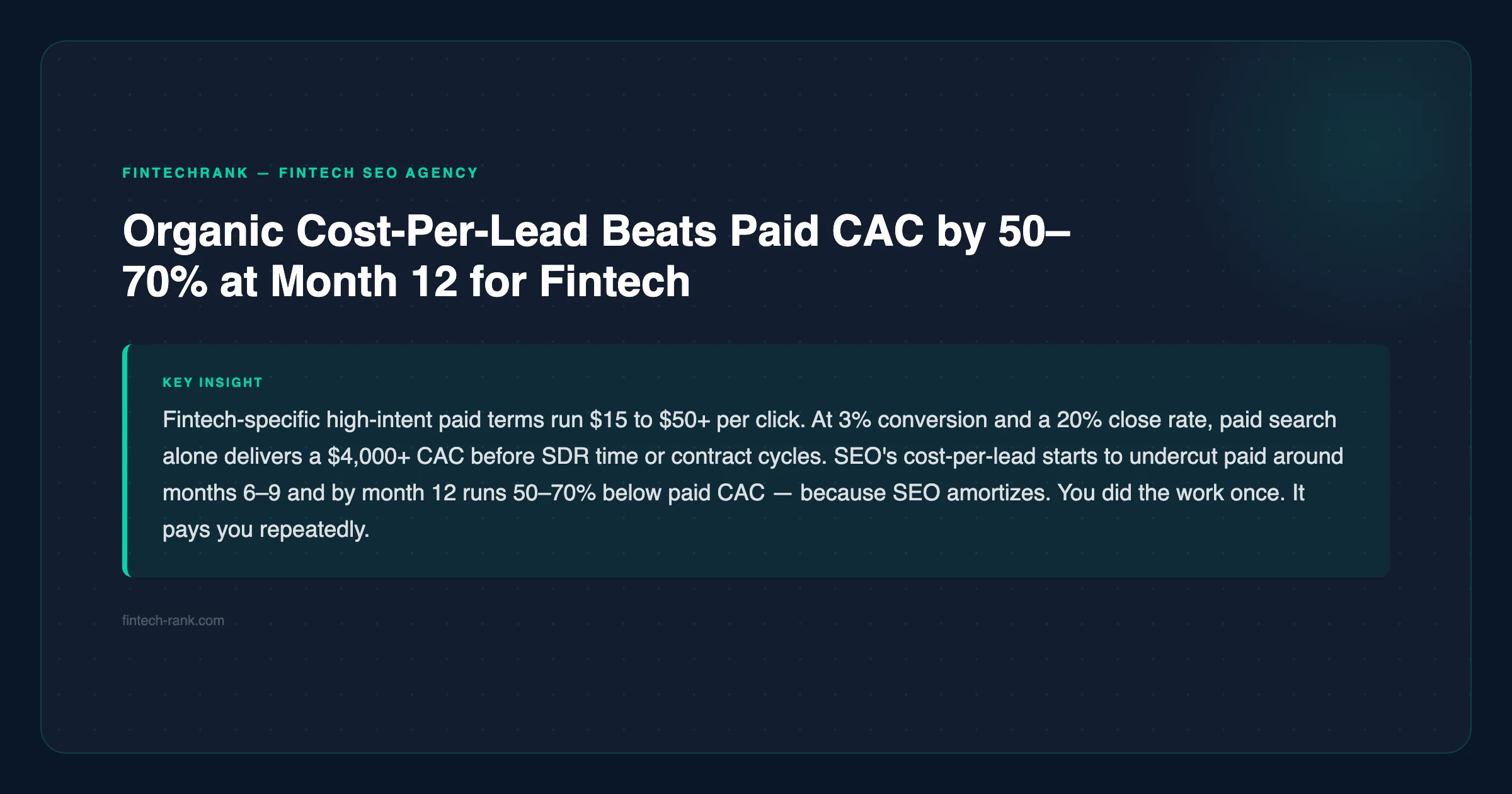
For an established domain (12+ months old, some existing content) targeting low-competition keywords (KD under 20), first rankings typically appear within 60-90 days. SEO’s cost-per-lead begins to undercut paid around months 6-9. By month 12, most fintech companies with a consistent content strategy see organic cost-per-lead running 50-70% below their paid search CAC. New domains or highly competitive keyword targets take longer.
Should a Series A fintech use paid ads or SEO?
Both, but in the right proportion. A Series A fintech with 12-18 months of runway and a $10k-$20k monthly marketing budget should allocate the majority to SEO (content, technical, and AEO) while keeping paid focused on branded terms and retargeting. The goal is to build an organic asset that reduces total CAC over time. Pure paid spend at Series A often results in unsustainable acquisition economics before you have the ARR to absorb it.