Fintech SEO Strategy for Startups: A 90-Day Plan That Actually Makes Sense

A fintech SEO strategy for startups should start with technical foundation in month one, move into keyword research and your first content cluster in months two and three, and shift to authority-building in months four through six. Most companies get this sequence wrong and end up publishing content on a site Google cannot properly crawl.
Organic search is one of the most reliable acquisition channels in fintech but it is also one of the most misunderstood.
Most SEO content for fintech startups reads like a generic tactics list. Pick keywords. Write blogs. Build backlinks. Repeat. What those posts skip is the part that actually determines whether any of it works: the sequence.
If you are a VP of Marketing or Head of Growth at a Series A-C company, you probably have one marketing hire (or half of one), a content budget that competes with every other channel, and a leadership team asking for results in 90 days. This post is for you.
No tactics dump. A sequenced plan: what to do first, what to defer, and how to know if it is working.
Why SEO Is Different for Fintech Startups

Before the plan, three things that make fintech SEO harder than the generic advice suggests.
You are in YMYL territory. Google’s “Your Money or Your Life” classification applies to most fintech content: payments, lending, investments, insurance. Content in this category is held to a higher trust standard. Author credentials, factual accuracy, and editorial review are not optional.
You have limited resources. You are not a Nerdwallet or a Bankrate with 50 writers and a $2M content budget. You need a prioritised plan that generates real signal from a small footprint.
SEO compounds slowly. First-page rankings for most competitive fintech keywords take six to twelve months. The companies that win are the ones that start building before they need the results. According to Ahrefs’ beginner’s guide to SEO, the sites ranking in the top ten positions are usually two to three years old. Shorter timelines are possible but only if you target the right keywords.
The 3-Phase Fintech SEO Starter Plan
Phase 1 (Month 1): Technical Foundation
Before you write a single word of content, your site needs to be in a state that Google can actually work with.
What to do in month one:
Set up Google Search Console and submit your sitemap. This gives you baseline data and tells you whether Google is finding your pages at all.
Audit Core Web Vitals. LCP should be under 2.5 seconds. CLS should be below 0.1. INP should be under 200ms. These are not vanity metrics: they affect how Google evaluates page experience, particularly in YMYL categories.
Add structured data (schema markup) to your key pages. For a fintech site, this means at minimum: Organization schema, WebSite schema, and BreadcrumbList.
Set up author bios with credentials. Every blog author needs a named bio page that includes relevant expertise.
Check crawlability. No broken internal links, no pages accidentally blocked by robots.txt, no duplicate content from staging environments leaking into your canonical URLs.
What to defer: Do not worry about backlinks, social promotion, or content volume in month one. Fix the foundation first.
Phase 2 (Months 2-3): Keyword Research + First Content Cluster
With a clean technical foundation, month two is where you define what you want to rank for and publish your first cluster.
The key insight for fintech startups: you should not be chasing the same keywords as Nerdwallet. Target low-competition, high-intent queries specific to your product category.
When we ran keyword research for a B2B SaaS payments client, the mistake their previous agency had made was going after broad terms like “payment processing” (KD 78). The opportunity was in the product-specific queries: “embedded payment processing for SaaS” (KD 11, 320 searches per month). Less volume, far less competition, and searches made exclusively by people already in the buying decision. Those are the ranking factors for fintech that actually drive pipeline.
What to do in months two and three:
Build a keyword map around your product category. Focus on keywords with KD under 20 as your primary targets. Learn more in our fintech keyword research guide.
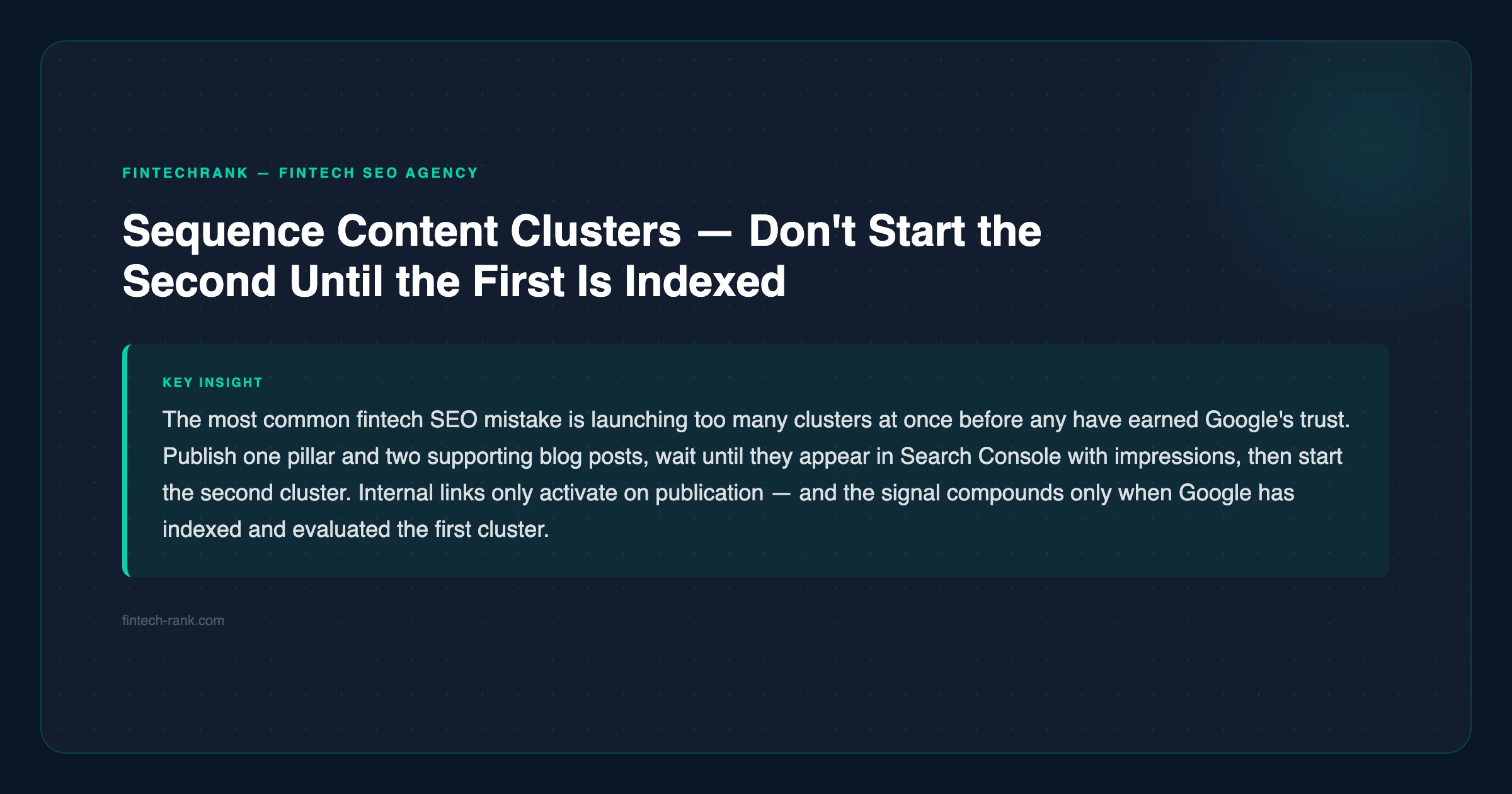
Choose a content model: one pillar page plus two supporting blog posts. The pillar covers the broad topic. The blogs go one level deeper. This creates the internal link structure that tells Google your site has real authority on the topic.
Write the pillar first. It should be 2,500-4,000 words, cover the topic comprehensively, and link out to both supporting blogs once they are published.
Publish both supporting blogs within the same month. Internal links activate on publication.
What to defer: Do not start a second cluster until the first one is indexed and showing impressions in Search Console.
Phase 3 (Months 4-6): Build Authority
By month four, you should have a technically clean site and at least one indexed content cluster.
What to do in months four through six:
Run a systematic internal linking audit. Every new piece of content should link back to your pillar. Every pillar should link to your service pages.
Start backlink outreach. Fintech is a strong environment for earning links from industry publications: FF News, Finextra, The Paypers, and trade-specific media all publish contributed content. One relevant backlink from a fintech publication is worth more than fifty generic directory links.
Set a content refresh cadence. Any blog post that ranked in positions 8-20 after three months is a candidate for a refresh.
Add a second content cluster. By month four, your first cluster has given you real data. Use that data to inform which cluster to build next.
What “Done” Looks Like at Month 3
- Google Search Console connected and showing indexed pages
- Core Web Vitals passing (or a documented plan to fix any failures)
- Schema markup on all key pages, validated with Google’s Rich Results Test
- Author bios live with credentials listed
- One content cluster published: one pillar, two supporting blogs
- Internal links between all three cluster pages and your main service page
What “Done” Looks Like at Month 6
- First-page rankings for two to four low-competition keywords in your primary cluster
- 200-500 organic sessions per month from the cluster content
- At least one lead or trial signup attributable to organic search
- A second content cluster underway
- Three to five quality backlinks from relevant fintech or B2B publications
- A documented keyword map covering your top two product areas
These are conservative benchmarks for a site starting from zero in a compliant, properly structured fintech niche.
Signs Your SEO Is Working (and Signs It Is Not)
Working:
- Indexed page count in Search Console is growing month over month
- Impressions are increasing even before clicks follow
- Your target keywords are appearing in Search Console’s “Queries” report at any position
- Organic sessions show a slow upward trend from month three onward
Not working:
- No impressions after six weeks for published content (crawl or indexing issue)
- Keyword positions flat or declining after month four (possible E-E-A-T signal problem)
- All traffic arriving on your homepage rather than individual blog posts
When to Hire a Fintech SEO Agency
Running SEO yourself is possible, especially in months one through three. Where in-house execution typically breaks down:
- When content production competes with product marketing, demand gen, and everything else on one person’s plate
- When the YMYL editorial review adds friction that delays publication by weeks
- When backlink outreach requires more relationship bandwidth than you have in-house
- When you need AEO and no one on the team has built that before
A good fintech SEO agency understands compliance-sensitive content, builds content clusters around your specific product category, and includes AI search optimization without treating it as an upsell. Our complete fintech SEO guide covers what an engagement should include.
FAQ
What should a fintech company do first with SEO?
Fix your technical foundation before publishing any content. Set up Google Search Console, audit Core Web Vitals, add schema markup to key pages, and ensure author bios with credentials are live on every piece of content. A technically clean site makes every subsequent content investment more effective.
Can a small fintech team run SEO without an agency?
Yes, particularly in the first 90 days. The technical foundation and first content cluster are structured enough that a single marketing hire can execute them with a clear plan. Where teams typically need help is in sustaining a publishing cadence while managing other channels, and in adding AI search optimization (AEO) alongside traditional SEO.
How much should a fintech startup budget for SEO?
The range is wide: from $750/month for a specialist retainer to $10,000+/month for enterprise agency engagements. The more important question is what the budget buys. A $750/month retainer that includes keyword strategy, content creation, on-page optimization, and AEO is a different product than a $5,000/month engagement that delivers a monthly report and a list of recommendations.