Financial SEO Audit: A Compliance-Aware Checklist for Fintech Companies

Most SEO audits for fintech sites are built for ecommerce. They score your title tags, flag missing alt text, and hand back a 60-page PDF that legal cannot use and engineering will not prioritise. None of it explains why the compliance team rejected the last three blog posts or why the new product page is sitting on page four.
A proper financial SEO audit is different. It checks the same technical fundamentals every audit covers, then adds the layer that actually decides what ships in fintech: regulatory awareness. FINRA, SEC, GDPR, and the disclosure language that quietly tanks rankings when it sits in the wrong place. This guide walks through what a compliance-aware audit checks, a 90-minute version you can run yourself today, and how to decide whether to keep doing it in-house or bring in someone who lives in this stuff.
Why generic SEO audits fail fintech sites

Most audit templates were built for content commerce. The assumption is that every page is free to say whatever ranks. In fintech, that assumption breaks the moment a compliance reviewer opens the doc.
Three things go wrong every time:
Keyword targets ignore the legal vocabulary. A generalist will recommend “best high yield savings account” because the volume is good. A fintech operator knows that exact phrase triggers FINRA Rule 2210 review, gets stripped of qualifiers, and ships as a sentence the buyer no longer recognises. Audits that do not account for what your legal team will actually approve produce keyword lists that go nowhere.
Schema recommendations skip financial product types. Most audit tools flag generic Product or Article schema and stop there. Fintech needs FinancialProduct, FinancialService, or LoanOrCredit schema with the right fee and rate fields, plus disclosure handling. Skip that and AI search engines will not cite your product correctly, even when the page ranks.
Disclosure placement gets ignored. The “as of” date, the rate disclosure, the regulatory body, the deposit insurance footer. These are not optional in regulated copy, and they affect crawlability, content depth scoring, and whether AI Overviews surface your page at all. A generic audit treats them as boilerplate. They are not.
What a fintech-aware audit checks
A compliance-aware financial SEO audit covers the standard SEO surface plus six items most templates skip. Treat this as the minimum bar.
1. Keyword mapping against regulatory constraints
Every priority keyword gets tagged for which regulators apply (FINRA, SEC, GDPR, state-level if you sell into specific markets). If a phrase requires a disclosure, the audit notes which one, where it must appear on the page, and how that affects the H1, meta description, and intro paragraph. The deliverable is not a keyword list. It is a keyword list legal will actually sign off on.
2. Schema for financial products and services
Audit reviews whether the right schema type is in use, whether interest rates and fees are marked up correctly, and whether disclosures are linked or embedded in a way Google can parse. Wrong schema is one of the most common reasons regulated fintech pages do not appear in rich results despite ranking well.
3. Disclosure handling and YMYL signals
Google’s Your Money or Your Life framework applies to almost every fintech page. The audit reviews E-E-A-T signals (author bios with credentials, citation density, last-updated dates), disclosure placement (above the fold for product claims, footer for regulatory body and deposit insurance), and whether content depth matches the YMYL bar. Thin pages on financial topics get suppressed. The audit flags which ones.
4. Regulatory language in metadata
Title tags and meta descriptions get scrutinised by compliance more than any other element on the page because they show in SERPs. The audit checks for absolute claims (“best,” “guaranteed,” “highest”), unqualified rate quotes, and missing “as of” framing. Then it rewrites them so they pass legal and still earn clicks.
5. AI search citability for compliance buyers
Compliance officers, fintech CFOs, and risk leads use ChatGPT, Perplexity, and Google AI Overviews to research vendors. The audit checks whether your pages are structured to get cited: clear question-driven H2s, citable passages under 60 words, accurate schema, and authoritative external citations to regulators and standards bodies.
6. Content gap by regulatory event
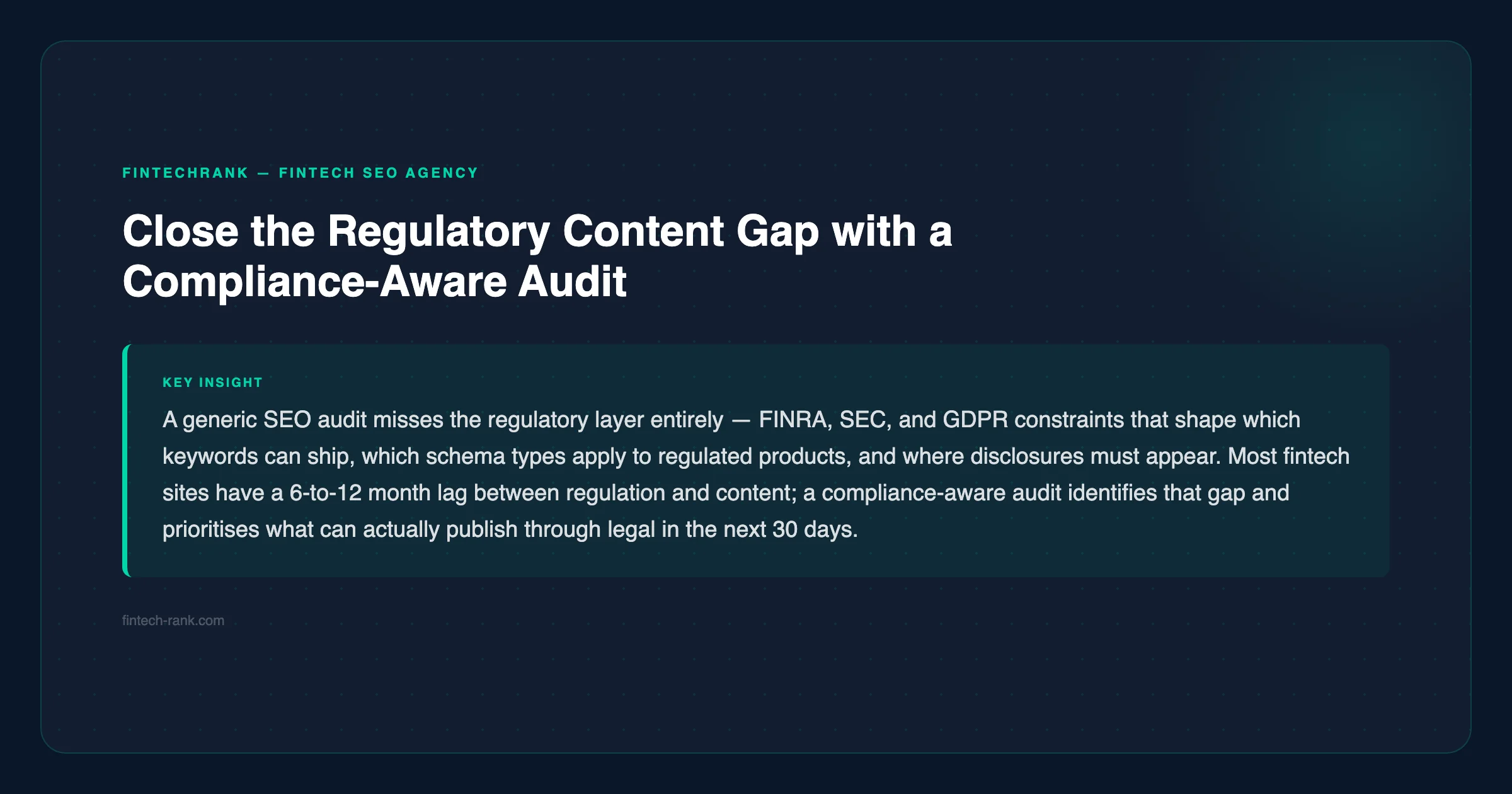
Audit cross-references your content with recent regulatory events (new FINRA notices, SEC rule proposals, GDPR enforcement actions, DORA milestones). Most fintech sites have a 6 to 12 month lag between regulation and content. Closing that gap is one of the highest-ROI fixes in the entire audit.
7. Internal linking around buyer-stage clusters
Audit maps internal links to confirm the awareness, comparison, and decision pages all connect. In regulated content, this matters more than most niches because compliance often forces topics into separate pages (you cannot bundle three product types on one page without triggering review). Internal linking is what stitches them back together for both Google and the buyer.
DIY: a 90-minute financial SEO audit you can run today
You do not need a tool stack to start. Block 90 minutes, open your top 20 pages by traffic, and walk this list.
- Indexation check (10 min). Pull your indexed pages from Search Console. Confirm your priority pages are indexed. Note any product, pricing, or service page that is not.
- Title and meta sweep (15 min). For each page, check the title tag (under 60 characters, primary keyword in first 10 words, no unqualified claims) and meta description (under 155 characters, primary keyword present, “as of” or disclosure framing where rates appear).
- H1 and intro (15 min). Confirm the H1 carries the target keyword without absolute claims. Check that the first 100 words include the keyword and any required regulatory framing.
- Schema spot check (10 min). Open three priority pages, view source, search for “@type.” Confirm financial product pages use FinancialProduct or a more specific subtype, not generic Product or Article.
- Disclosure audit (20 min). On every product or rate page, confirm the rate disclosure is above the fold, the “as of” date is current, and the regulatory body is named in the footer. Flag any page where these are missing.
- Internal links (10 min). Pick three buyer-stage clusters (awareness, comparison, decision). Confirm each page links to at least two others in the cluster.
- Compliance language flag (10 min). Search the page copy for “best,” “guaranteed,” “highest,” “lowest,” “always,” and “never.” Each one needs review. Most need to go.
Output a single page of fixes ranked by effort and ranking impact. That is your roadmap for the next four weeks.
When to DIY versus hire
Run the self-audit yourself if you have under 50 indexed pages, no technical SEO blockers, and an in-house writer who can fix metadata and intros. The 90-minute pass plus four weeks of fixes will move the needle.
Bring in a specialist when the audit surfaces schema issues, log-file crawl waste, regulatory phrasing risks across hundreds of pages, or a backlog of compliance-rejected drafts. The cost of getting this wrong in fintech is not a flat ranking. It is content that never publishes, legal review cycles that burn weeks, and AI search engines citing competitors instead of you.
What to do next
A financial SEO audit is the first thing we run for every new fintech client because it answers two questions at once: what is blocking growth, and what can ship through legal in the next 30 days. Generic audits answer the first. Only a compliance-aware financial SEO audit answers both.
If you’d rather have a starting framework than a generic checklist, the 2026 Fintech SEO Blueprint walks through the audit, content, and AEO playbook we use for every client.