Fintech SEO Agency: How to Pick One That Understands Compliance

A fintech SEO agency that doesn’t understand YMYL (Your Money or Your Life), compliance review cycles, and trust signals is a generic SEO agency calling itself fintech-aware. The difference shows up in how fast your content publishes, how much it ranks, and whether legal stops it.
Why fintech SEO is its own discipline

Fintech sits in Google’s YMYL category, where the search quality team applies stricter expertise, authoritativeness, and trust standards. Financial content that would rank in five weeks for a SaaS keyword takes three to six months on a new fintech domain because Google needs more trust signals before ranking sensitive content.
That changes the playbook. A generic SEO agency optimising for “best business loan” will produce content Google won’t rank, partly because the content is generic and partly because the domain doesn’t yet signal the trust required for YMYL ranking. The fintech-specialist agency works on three things in parallel: content quality, trust signal accumulation, and compliance-aware copy that won’t trigger legal pullback.
In our experience auditing fintech sites, the same pattern shows up: the previous agency wrote content that would have ranked on a SaaS site, struggled with YMYL trust thresholds, then asked for a 12-month patience window when nothing moved. The 12-month timeline is not a YMYL fact. It is a generalist agency hiding behind a YMYL excuse.
What a fintech-specialist agency does differently
Five operational differences separate a specialist from a generalist with a fintech service line.
1. YMYL trust signal sequencing. Before pushing high-volume content, a specialist verifies the trust foundation: about page with team credentials, security audit pages (SOC 2, ISO 27001), regulatory registrations (FINRA, FDIC, state licenses where applicable), author bios with relevant credentials. Trust signals compound. Without them, content sits unranked.
2. Compliance-coordinated content cycles. Customer-facing fintech content goes through compliance review at most regulated brands. A specialist builds review buffer into the content calendar (typically 5-10 business days per piece) and drafts language that tends to pass. A generalist publishes content without review and creates legal cleanup work later, or experiences 4-week production delays they didn’t plan for.
3. Risk-disclaimer-aware copywriting. Fintech content needs to balance ranking signals with required disclaimers (returns not guaranteed, regulatory caveats, eligibility restrictions). A specialist writes copy where disclaimers don’t kill the conversion narrative. A generalist either ignores disclaimers (compliance issue) or buries the headline benefit under three paragraphs of legal language (conversion issue).
4. Author authority strategy. YMYL content benefits from named authors with verifiable credentials. A specialist sets up author bio pages, claims author profiles in Google’s Knowledge Graph where possible, and builds individual author authority over time. A generalist publishes under a generic “Marketing Team” byline that signals neither expertise nor accountability.
5. Trust-relevant link building. Generic backlink campaigns target high-domain-authority sites regardless of relevance. A specialist targets fintech publications, regulatory body mentions, partner integrations, and review sites where citations carry trust weight. Quality over volume, with relevance as the filter.
For deeper reading on the underlying ranking dynamics, our fintech SEO strategy guide covers the YMYL framework in more detail.
Red flags when evaluating a fintech SEO agency
| Red flag | What it tells you |
|---|---|
| All case studies are non-fintech | They have not navigated YMYL or compliance review |
| Pitch focuses on “publishing 8 blog posts a month” | They are not factoring compliance review buffer into the calendar |
| Cannot name the YMYL framework or E-E-A-T | They are working from a 2019 SEO playbook |
| Service area limited to one US city | Local digital agencies optimise for local lead gen, not regulated national fintech |
| No mention of trust-signal sequencing in the audit phase | They will publish content before the foundation is ready |
If you want a deeper comparison between SEO and paid acquisition for fintech specifically, see our SEO vs paid ads for fintech breakdown.
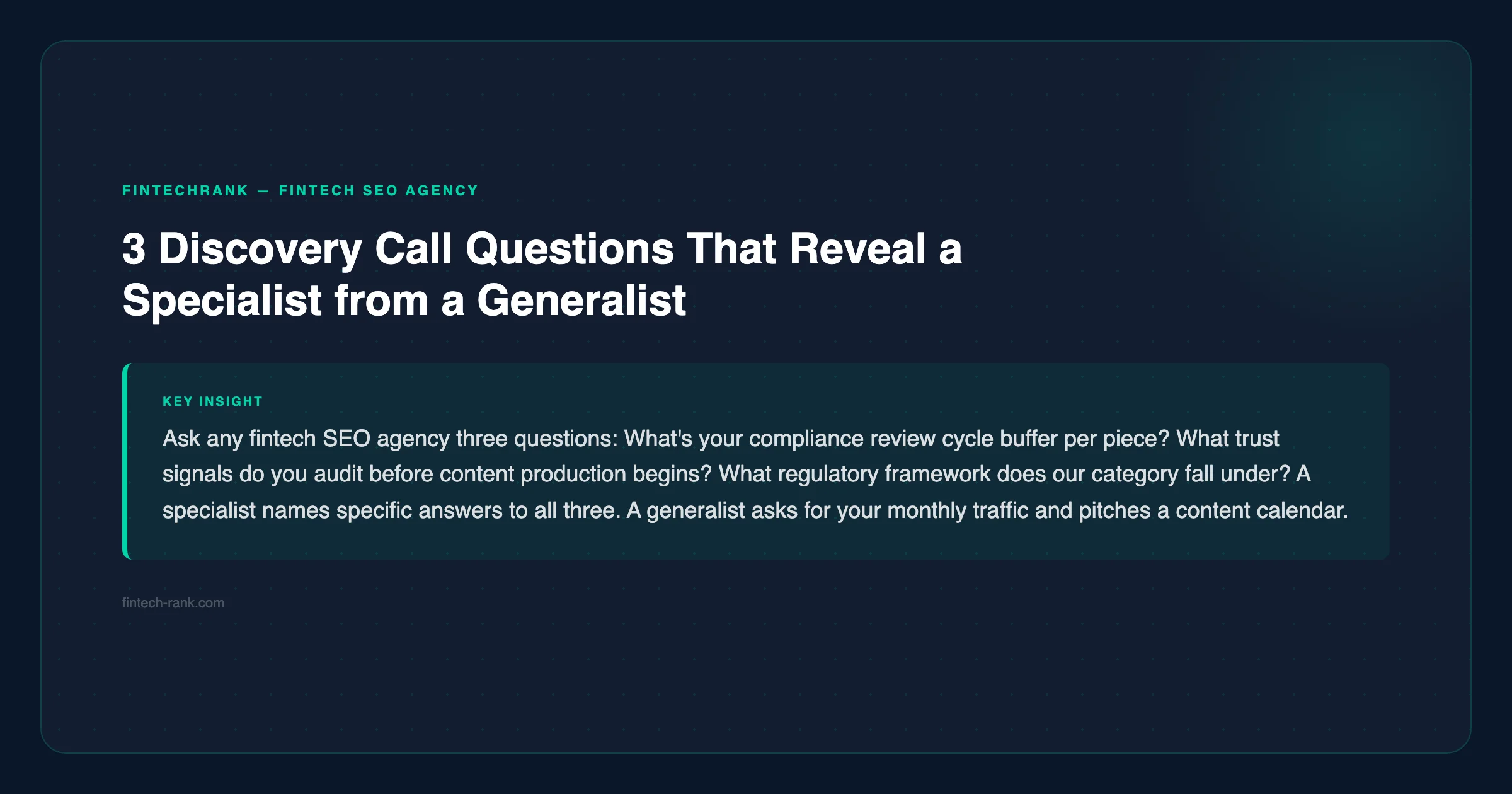
What a proper fintech SEO discovery call covers
Three questions a fintech-fluent agency asks in the first conversation:
- “What’s your compliance review cycle for marketing content?” Without this, no realistic content calendar can be built. Lead time matters more than volume.
- “What trust signals are already on your site, and which need to be added?” If they don’t ask about author bios, security audit pages, and regulatory disclosures, they aren’t planning for YMYL.
- “What’s the regulatory framework you operate under?” SEC, CFPB, FINRA, state-level money transmitter, EU MiCA. The answer changes which content can be written, which claims can be made, and which trust signals carry weight.
A specialist asks all three. A generalist asks for your monthly traffic and pitches a content calendar.
How FinTechRank works
FinTechRank is the productized SEO retainer for US fintech companies. Pricing is $750/month, published on the homepage with no discovery call required. Every engagement starts with a YMYL trust signal audit and compliance-cycle planning before content production begins. The full scope is in the fintech SEO guide.
FAQ
What makes fintech SEO different from regular SEO? Fintech sits in Google’s YMYL (Your Money or Your Life) category, which means Google applies higher quality and trust thresholds to fintech content. Compliance review cycles slow content production, regulatory disclosures shape on-page copy, and trust signals (security audits, licenses, registrations) matter more than backlink counts. Generic SEO playbooks miss all of this.
How long does fintech SEO take to show results? Low-competition fintech keywords can rank in 3-6 months once trust signals are in place. New fintech domains take longer because Google’s YMYL threshold requires more accumulated trust before ranking sensitive financial content. Established fintech brands with compliance maturity see faster movement.
Do fintech SEO agencies handle regulatory compliance? Specialist fintech SEO agencies coordinate with the brand’s compliance team on all customer-facing content but don’t provide compliance certification themselves. The agency drafts copy that ranks. Compliance review confirms it stays within regulatory boundaries. A specialist knows which language tends to pass and which triggers review delays.
How much does fintech SEO cost? Specialist fintech SEO ranges from $750/month (productized, published pricing) to $15,000/month (large agencies with dedicated fintech vertical teams). Mid-range $3,000-$8,000/month is most common. Compliance-aware content production costs more per piece because of review cycles, but compounds faster on YMYL queries.
If your fintech site is producing content that doesn’t rank or content that gets pulled in compliance review, the gap is usually structural. See if FinTechRank is the right fit for your business.