SEO for Fintech Companies: A Stage-by-Stage Playbook (Seed to Series C)

SEO for fintech companies takes 90 days to first ranking and 6 months to first paid customer from organic. The work changes radically between seed and Series C, and the biggest mistake is running the same playbook at every stage.
A seed-stage neobank does not need the link-building program a Series C lender needs. A Series A regtech does not need the brand-defense moat a Series C payments processor needs. Treating SEO as a single discipline is why most fintech companies spend two years and six figures without compounding traction. The stage decides the work.
This is the stage-by-stage playbook — what to do at seed, what to scale at Series A, what to optimize at Series B, and what to defend at Series C.
What is SEO for fintech companies?

SEO for fintech companies is the discipline of ranking regulated financial content on Google and in AI search (ChatGPT, Perplexity, Google AI Overviews) without breaking compliance. It blends three things: technical SEO (the usual crawlability, schema, Core Web Vitals), YMYL-aware content (Google’s stricter quality bar for financial topics), and compliance-coordinated publishing (drafting copy legal will approve on the first pass). Skip any one of the three and the program stalls.
Why does fintech SEO timing matter?
Because the work that compounds at Series C is wasted at seed, and the work that wins at seed is irrelevant by Series B. At seed, you cannot out-publish or out-link an incumbent. You can only own a tight cluster of low-difficulty, high-intent keywords your competitors ignored. At Series C, you cannot grow by adding more keywords. You have to defend the rankings you have and expand into adjacent categories. Matching the work to the stage is how fintech SEO produces compounding ROI instead of flat traffic charts.
Seed stage: what to do in months 1-12?
At seed, focus on 10 long-tail keywords that match your ICP’s pre-purchase questions and own them completely.
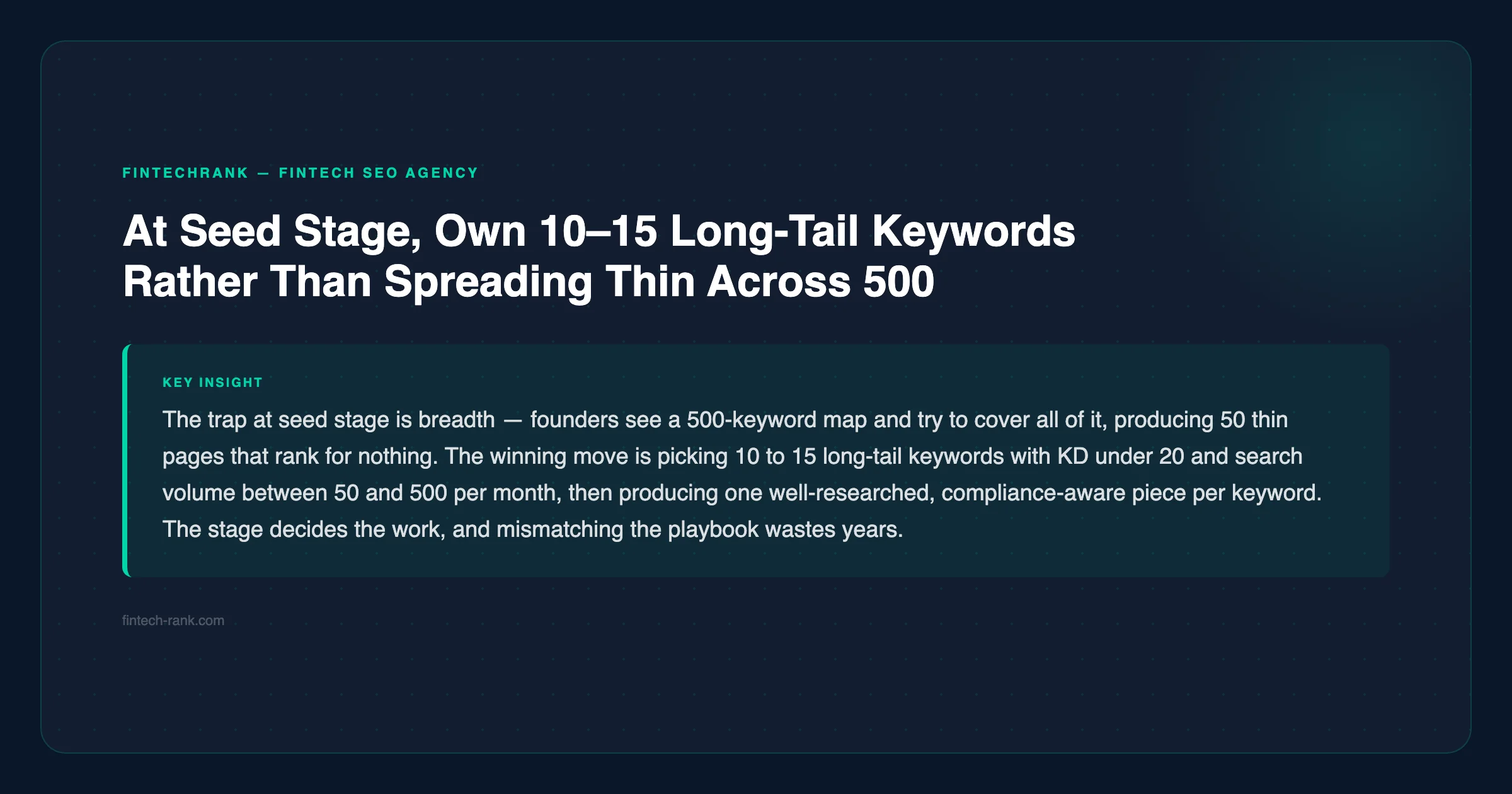
The trap at seed is breadth. Founders see a 500-keyword opportunity map and try to cover all of it. With one writer (or themselves), 500 keywords becomes 50 thin pages that rank for nothing. The winning move is the opposite: pick 10 to 15 long-tail keywords with KD under 20 and search volume between 50 and 500 per month, and produce one well-researched, compliance-aware piece per keyword.
Specific tactics:
- Foundation audit ($0 to $1,500). Before any content, fix the basics: title tags, meta descriptions, schema for any product pages (FinancialProduct or FinancialService), and a YMYL-grade about page with founder credentials. Two weeks of work or a one-off audit engagement.
- Cluster pick (KD under 20, volume 50-500). Use Ahrefs or SEMrush keyword difficulty as the filter. Avoid head terms like “best business loan” — they require trust signals you do not have yet.
- Content cadence: 2 pieces per month, 1,200 to 1,800 words each. Compliance review adds 3 to 5 business days per piece. Plan for it.
- Author authority from day one. Every post gets a named byline with a credible bio. Generic “Marketing Team” bylines kill YMYL ranking before they start.
- Budget: $750 to $2,500 per month. Below $750 you get generic content. Above $2,500 is overinvestment for a domain with no trust foundation. For more on the foundation pass, see our financial SEO audit framework.
Series A: what to scale?
At Series A, double the content cadence and add the first AI-citation infrastructure so you compound across Google and LLM search simultaneously.
By Series A you have funded growth targets and a marketing hire or two. The seed cluster should be ranking on a handful of keywords and producing the first organic leads. The job now is scale without losing the compliance discipline that got you here.
Specific tactics:
- Scale cadence to 4 to 6 pieces per month plus 1 pillar per quarter. Pillars are 2,500-word resource pages that link out to the cluster posts. They earn backlinks and AI citations the short pieces do not.
- Add AI search optimization. Question-driven H2s, citable passages under 60 words, llms.txt file, accurate schema. ChatGPT and Perplexity send referral traffic that paid channels cannot intercept.
- Build the first trust-signal pages. SOC 2 page, security overview, regulatory registrations, press mentions. These are not vanity — they raise the YMYL ceiling for every page on the site.
- Targeted link building. Fintech publications, regulatory body mentions, integration partner pages. Quality over volume. 2 to 4 placements per quarter is enough.
- Budget: $3,000 to $7,000 per month. This is the band where an external specialist outperforms an in-house junior hire by a wide margin. Methodology details in our fintech SEO strategy guide.
Series B: what to optimize?
At Series B, optimize for conversion and category authority — stop adding new keywords and start compounding the ones you already rank for.
By Series B, the keyword inventory is large enough that adding more is diminishing returns. The leverage moves to two places: improving the conversion rate of the traffic you already get, and consolidating category authority so AI search and journalists cite you by default.
Specific tactics:
- CRO on top 20 pages. Audit the highest-traffic posts and product pages for clarity of offer, social proof, and CTA placement. A 1 percent lift on a 5,000-monthly-visit page is worth more than a new ranking.
- Refresh, do not republish. Update the top 30 pages quarterly with new data, regulatory changes (FINRA notices, SEC rule updates), and refreshed examples. Google rewards freshness on YMYL content. See the fintech keyword research process for how to identify which pages to prioritize.
- Earned media and original research. Publish one original data study per quarter. Data studies earn the backlinks generic content cannot. They are the single highest-leverage SEO asset at this stage.
- Internal team build. Bring SEO in-house or move to a senior specialist relationship. Junior hires struggle here; the work is strategic, not production.
- Budget: $8,000 to $20,000 per month between content, links, and tools, or equivalent in-house headcount.
Series C: what to defend?
At Series C, defend the rankings you have, expand into adjacent categories, and own brand-defense queries that protect a $100M+ ARR pipeline.
By Series C, you have a defensible position on dozens of keywords. Competitors will target them. Reviewers, comparison sites, and AI search engines will write about you with or without your input. The work becomes defensive and reputational.
Specific tactics:
- Brand SERP defense. Own page one for “[your brand] reviews”, “[your brand] alternatives”, “[your brand] vs [competitor]”. Comparison and alternatives pages built in-house, not left to G2 and Reddit. For the framework, see our SEO vs paid ads breakdown on why brand defense beats paid retargeting.
- Adjacent category expansion. Use existing domain authority to enter adjacent search categories — a payments company expanding into expense management, a neobank expanding into business credit. The domain authority transfers; the keyword inventory does not.
- International SEO. Hreflang setup, localized content for EU, UK, LATAM markets where applicable. Series C is when the international SEO investment finally pays back.
- AI search ownership. Direct relationships with AI search platforms where possible, structured data audits quarterly, llms.txt maintained, knowledge panel claimed.
- Budget: $20,000+ per month, typically a hybrid in-house team plus external specialists for technical and link work.
Stage-by-stage comparison
| Stage | Primary SEO Goal | Monthly Budget Range | Content Cadence | Lead Volume Target |
|---|---|---|---|---|
| Seed | Own 10-15 long-tail keywords | $750 - $2,500 | 2 posts / month | 5 - 15 leads / month by month 9 |
| Series A | Scale cadence + AI citations | $3,000 - $7,000 | 4-6 posts + 1 pillar / quarter | 30 - 80 leads / month |
| Series B | CRO + category authority | $8,000 - $20,000 | 6-10 posts + refreshes + 1 study / quarter | 150 - 400 leads / month |
| Series C | Brand defense + expansion | $20,000+ | 10+ posts + international + earned media | 500+ leads / month |
The biggest mistake at every stage is borrowing the playbook from the stage above. Series A tactics at seed produce thin content. Series B tactics at Series A skip the trust foundation. Series C tactics anywhere else are pure overinvestment. Match the work to the stage.
If you are at seed or early Series A and want a sense of what the home stretch of compliance-aware fintech SEO actually looks like in practice, the rest of this site is the playbook.
FAQ
How long does SEO for a fintech company take to produce results? SEO for fintech companies typically takes 90 days to first ranking on low-difficulty keywords (KD under 20) and 6 months to first paid customer attributable to organic. New fintech domains run longer because Google’s YMYL framework requires more accumulated trust before ranking financial content. Established fintech brands with existing trust signals can compress this.
How much should a seed-stage fintech spend on SEO? At seed, budget $750 to $2,500 per month. That covers a focused content cadence (2 to 4 pieces), basic on-page work, and compliance-aware copywriting. Anything below $750 produces generic content that legal will not approve. Anything above $2,500 is wasted until the trust foundation is in place.
When should a fintech company move from SEO to a full content team? Around Series B, when organic is consistently producing 30 percent or more of pipeline and the content cadence outgrows what an external partner can deliver weekly. Before Series B, an external specialist is faster, cheaper, and more compliance-fluent than a junior in-house hire.
Is SEO worth it for B2B fintech with a long sales cycle? Yes, especially for B2B fintech. Long sales cycles mean buyers research extensively before contacting sales. SEO captures that research window. Ranking for intent-rich queries like “best [category] for [company type]” or comparison terms intercepts pipeline that paid channels miss entirely.
Can fintech SEO survive compliance review without slowing down? Yes, when content is drafted compliance-aware from the start. A specialist writes copy that tends to pass on first review (3 business days per piece). Generalist content gets redlined into a 2 to 3 week back-and-forth that kills cadence. The difference is upstream, not downstream.