Fintech SEO Audit Checklist: 27 Items That Actually Matter

Most fintech SEO audits hand back a 60-page PDF, a list of broken links, and a vague suggestion to “improve your content quality.” None of that tells you why the page targeting your highest-intent keyword is stuck on page nine, or why legal killed the last three drafts before they shipped.
This checklist is built for the founder running their first real audit. No fluff. Twenty-seven items, grouped by what actually changes rankings in fintech: technical foundation, on-page signals, content depth, schema, and the compliance layer most generalist audits skip.
Run through it before you hire anyone. The exercise alone will surface 60% of what a paid audit would find.
Why a Fintech SEO Audit Checklist Looks Different

A standard SEO audit treats every site the same. Fintech is not the same.
You sit in YMYL territory (Your Money or Your Life), which means Google holds your content to a higher trust bar. Your compliance team can kill a page in legal review weeks after it ships. Your schema needs to describe regulated products, not generic services. And your authors need credentials that hold up to a quality rater asking “would you trust this person with your money?”
A fintech-specific audit checks all of that on top of the standard work. If you only run a generic audit, you will miss the layer that decides whether your content earns rankings or stalls.
For the longer methodology behind why this matters, see our financial SEO audit framework and the fintech SEO audit service page.
The 27-Point Fintech SEO Audit Checklist
Technical Foundation (8 items)
- Google Search Console connected, sitemap submitted, no coverage errors above 5%.
- Core Web Vitals passing across mobile and desktop. LCP under 2.5s, CLS below 0.1, INP under 200ms.
- Robots.txt reviewed. No accidental disallow on /blog/, /guides/, or service paths.
- Canonical tags set on all indexable pages. No staging URLs leaking into the index.
- HTTPS sitewide. No mixed-content warnings on financial product pages.
- Site loads under 2 seconds on 4G. Test from a US data centre, not your office wifi.
- XML sitemap excludes parameter URLs, login pages, and any /admin routes.
- Mobile usability passes for every indexable URL. Run a sample crawl on your top 50 pages.
On-Page Signals (6 items)
- Title tags under 60 characters. Primary keyword in the first 10 words on every page.
- Meta descriptions under 155 characters. Each one unique. No truncated descriptions on key landing pages.
- One H1 per page. Hero copy includes the primary keyword naturally, not stuffed.
- H2 structure follows search intent. Each H2 maps to a sub-question a buyer would type.
- Image alt text present on every content image. Hero alt includes the primary keyword.
- Internal links audited. Every blog post links up to a pillar and across to a sibling. No orphan pages.
Content Depth (5 items)
- Top 10 pages have at least 800 words of substantive content. Thin landing pages stripped or rewritten.
- Author bio block on every blog post and guide. Name, credentials, photo, LinkedIn link.
- Publish date and last-updated date visible on every editorial page.
- Factual claims sourced. Statistics linked to original research or named publications.
- No duplicate content across blog posts and service pages. Each URL targets one keyword.
Schema Markup (4 items)
- Organization schema on the homepage. Includes legal name, logo, and sameAs to LinkedIn.
- BlogPosting schema on every blog post. Author, datePublished, dateModified, image.
- FAQPage schema on pages with a real Q&A block. Questions match user search phrasing.
- Product or Service schema on regulated product pages. Describe the product accurately. Misrepresenting a regulated product in schema is a compliance issue, not just an SEO one.
Compliance Layer (4 items)
- Disclosures present on any page making rate, return, or product claims. Visible above the fold or one scroll down. Not buried in the footer.
- Claim language reviewed. No phrases that imply guaranteed returns, risk-free investing, or unverified product superiority.
- Author credentials match the topic. A piece on lending compliance written by an unnamed staff writer fails the YMYL bar even if the SEO is clean.
- Review process documented. Every published page has a named reviewer and a date. This is the proof Google’s quality raters look for.
What to Do With the Results
Score yourself out of 27. Anything 22 or above is a healthy starting point. Below 18 means the foundation has gaps that will block rankings even if you publish more content.
Common patterns from real audits:
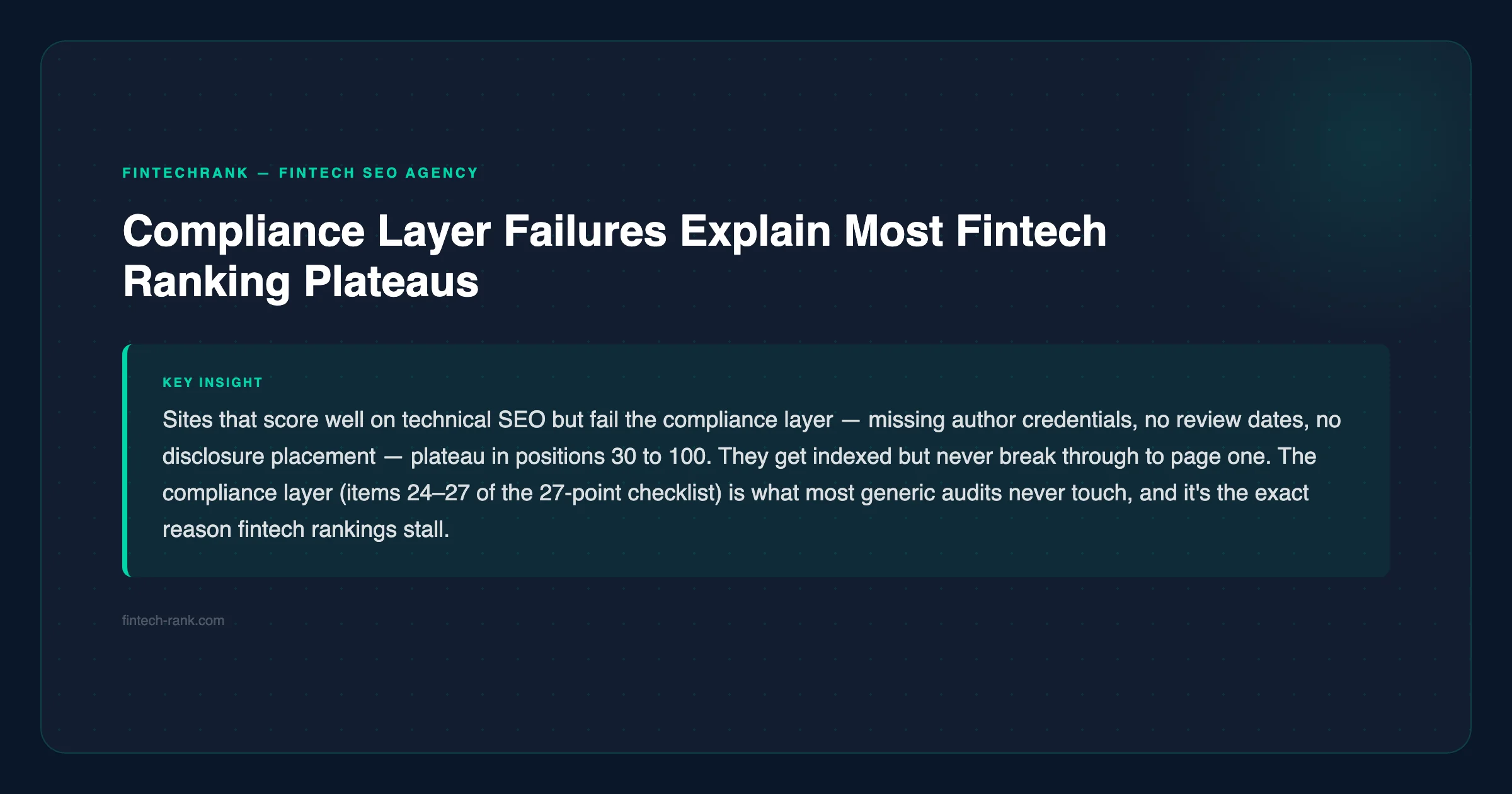
- Sites scoring well on technical (1 to 8) but failing the compliance layer (24 to 27) tend to plateau in positions 30 to 100. They get indexed but never break through to the first page.
- Sites passing compliance but failing schema (20 to 23) lose AI search visibility. ChatGPT, Perplexity, and Google’s AI Overviews lean heavily on structured data to decide what to cite.
- Sites with strong content depth (15 to 19) but weak internal linking (item 14) waste their best assets. The pages exist but Google cannot connect them to the rest of the site.
Pick the lowest-scoring section and fix that first. Do not try to address all 27 in one sprint.
When to Stop Auditing and Start Fixing
The audit is not the work. It is the diagnosis.
If you are running this yourself for the first time and the score lands above 18, prioritise the bottom three items, fix them in two weeks, and re-run the relevant section. If the score is below 18, the foundation needs work before publishing more content makes any difference. New posts on a broken site is a slow way to waste a content budget.
For the strategic context behind why we sequence audits this way, our fintech SEO strategy post covers the 90-day plan we recommend for first-time SEO buyers in regulated industries.
If you want a second pair of eyes on your audit results, we run fintech SEO audits as the first work in every engagement. The output is a prioritised fix list, not a 60-page PDF.
FAQ
How long does a fintech SEO audit take?
A self-audit on your top 20 pages takes 90 minutes if you have Search Console and a crawl tool ready. A full audit covering technical, content, schema, and compliance layers usually takes two to three weeks. Speed matters less than scope. Audits that skip the compliance layer are the reason most fintech sites stall.
What is the most common fintech SEO audit miss?
Disclosures and YMYL signals. Most generic audits score schema and crawlability but ignore whether the page has author credentials, factual citations, and review dates. For fintech, those signals weigh more than they do in other niches. Pages that miss them sit in positions 30 to 100 even when the technical setup is clean.
Do I need a fintech-specific audit or will a general SEO audit work?
A general audit will catch the technical basics. It will miss the regulatory layer and the YMYL signals that decide whether your content earns trust. If you ship anything that touches money, identity, or financial advice, the audit needs to include compliance phrasing review and disclosure placement.
Camilla Gleditsch is the founder of FinTechRank, a fintech-specialised SEO operation for early-stage US fintech companies. Connect on LinkedIn.