Fintech Schema Markup: The 6 Schema Types That Move Rankings

Schema markup is the part of SEO most fintech founders skip. The work feels technical and the impact feels invisible. Both assumptions are wrong.
Schema is how you tell Google, ChatGPT, and Perplexity what your page actually is, in a format they can parse without ambiguity. For fintech, where a single page can describe a regulated product, an editorial article, and an author with credentials all at once, that disambiguation is what decides whether the page gets cited or ignored.
This is the short list of what to add and where, with the compliance traps that catch fintech teams the first time they implement it.
Why Fintech Schema Is Different

Most schema guides treat every site the same. Fintech has two specific complications.
The first is regulatory. Your product schema describes a regulated financial product. If the JSON-LD misstates a rate, fee, or risk profile, that misstatement exists in machine-readable form on your site. Compliance review applies to schema the same way it applies to copy.
The second is YMYL. Google’s quality raters check structured data on YMYL pages more carefully than they do on a recipe blog. Author schema, organisation schema, and review markup all feed into the E-E-A-T signal. We covered the broader trust layer in the YMYL SEO for fintech post; schema is one of the concrete page elements that proves it.
Done right, schema lifts both your traditional rankings and your AI search visibility. Done wrong, it creates a compliance liability you did not have before.
The Six Schema Types Every Fintech Site Needs
1. Organization Schema
Goes on the homepage. Tells Google who you are as an entity.
Include legal name, logo URL, founder name, sameAs links to LinkedIn and any verified public profiles. For fintech, add the regulator registration if applicable. A licensed entity that names its registration in schema gets parsed differently from an unlicensed marketing site claiming the same products.
2. WebSite Schema
Goes on the homepage alongside Organization. Enables sitelinks search box and tells Google your canonical site URL. One JSON-LD block, ten lines of code, surprisingly underused on fintech sites.
3. BreadcrumbList Schema
Goes on every page with breadcrumb navigation. Helps Google understand your site hierarchy and improves the URL display in search results. For fintech sites with deep service or product hierarchies, this is non-optional.
4. BlogPosting Schema
Goes on every blog post and editorial guide. Include headline, datePublished, dateModified, image, author with Person schema, and publisher with Organization schema. The dateModified field in particular signals freshness on YMYL content. A post reviewed in the last 12 months reads as actively maintained.
5. FAQPage Schema
Goes on pages that have a real Q&A section. The questions in your schema must match the questions in your visible page content word for word. Mismatched FAQ schema is a manual action risk.
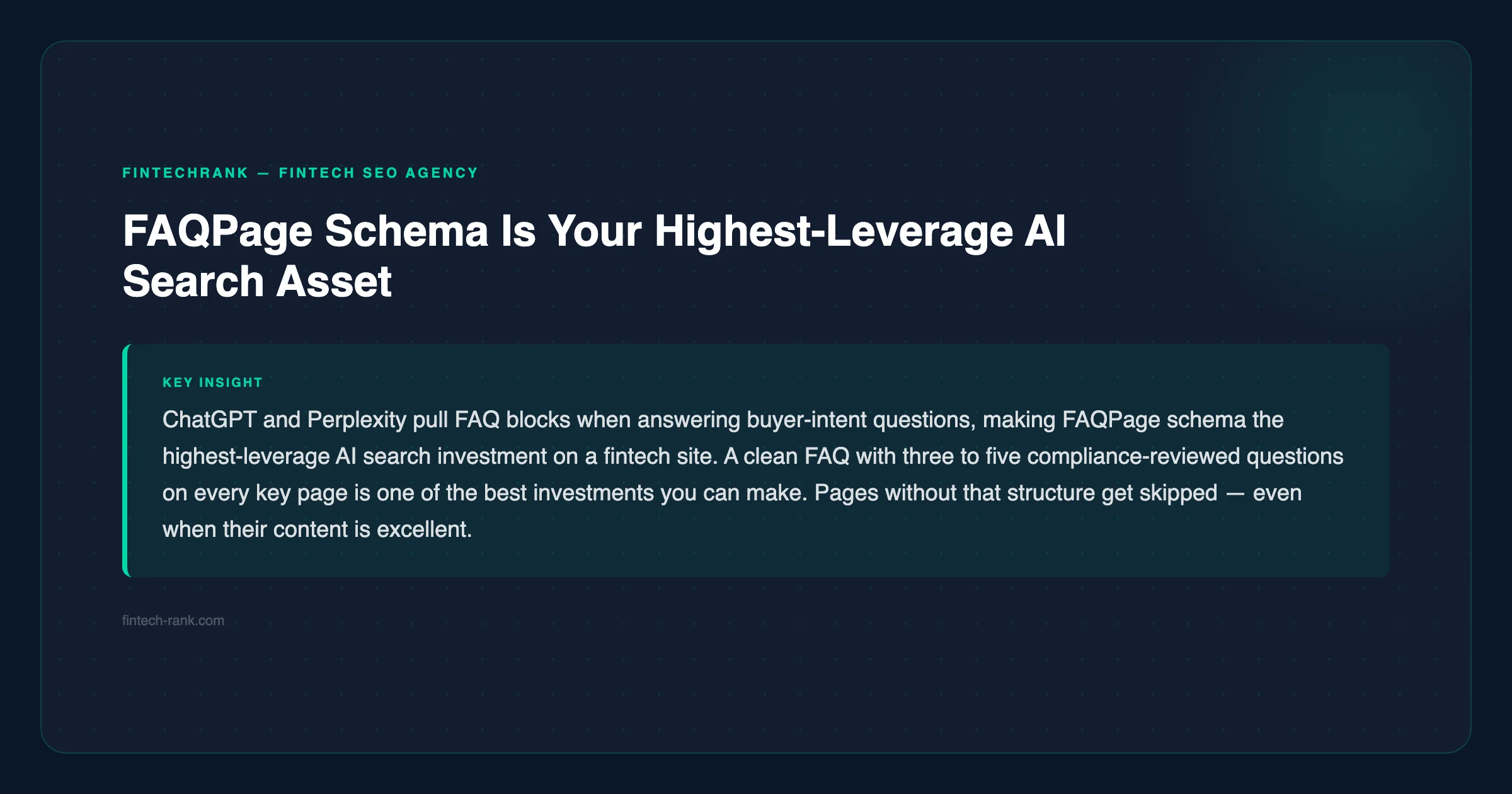
For fintech, FAQ schema is also the highest-leverage AI search asset on your site. ChatGPT and Perplexity pull FAQ blocks when answering buyer-intent questions. A clean FAQ with three to five questions on every key page is one of the best investments you can make.
6. FinancialProduct Schema
Goes on regulated product pages. Use FinancialProduct (or its more specific subtypes: BankAccount, LoanOrCredit, InvestmentOrDeposit, PaymentCard) when the page describes an actual regulated offering.
This is where compliance review matters most. Every numeric field in the schema (interestRate, feesAndCommissionsSpecification, annualPercentageRate) must match what the page itself states and what the legal team has approved. Treat the schema review as part of the same workflow as the page copy review.
How Schema Affects AI Search Visibility
Traditional SEO ranks pages. AI search ranks passages and structured facts.
When ChatGPT answers a question about, say, embedded lending compliance, it pulls structured passages from sites that have made those passages easy to extract. FAQPage schema, BlogPosting schema with a clear headline, and clean Product schema all make a page more extractable. Pages without that structure get skipped even when their content is excellent.
For fintech specifically, AI Overviews and Perplexity citations have become a meaningful traffic source. A site with clean schema gets cited as the source of an answer. A site with the same content and no schema watches a competitor get the citation instead.
The fintech SEO audit checklist covers schema as items 20 to 23 of the audit. If you have not run it yet, that is the fastest way to identify which schema types are missing.
The Three Schema Mistakes Fintech Sites Make
Mistake one: copy-pasted Product schema. Using Product schema on a regulated financial product. The Schema.org specification has FinancialProduct and its subtypes for a reason. Generic Product schema on a lending product is technically valid but loses the granularity that lets Google parse the offering correctly.
Mistake two: FAQ schema with hidden questions. Adding FAQPage schema for questions that do not appear in the visible page content. This is a guidelines violation and can trigger a manual action. The questions in your schema must match the questions on your page exactly.
Mistake three: Author schema with no Person backing. A BlogPosting schema with "author": {"@type": "Person", "name": "Editorial Team"} and no actual Person schema or author page behind it. Google’s quality raters check the linked author pages. A schema author with no real person behind it weakens the YMYL signal instead of strengthening it.
What to Implement First
If you are starting from zero, sequence in this order:
- Organization and WebSite on the homepage. Half a day’s work.
- BlogPosting on every existing blog post. Most CMSs add this automatically; verify it is correct.
- FAQPage on your three highest-priority pages. This is the AI search lever.
- Person schema on author pages, with sameAs to LinkedIn.
- BreadcrumbList sitewide.
- FinancialProduct on regulated product pages, with compliance review.
Validate every schema block in Google’s Rich Results Test before deploying. Errors in JSON-LD silently kill the markup; the page renders but Google ignores the schema.
For the broader strategy that schema fits into, see our fintech SEO strategy post and the full fintech SEO audit service page.
FAQ
What schema markup does a fintech site need?
Six schema types cover most fintech sites. Organization on the homepage, WebSite for sitelinks search, BreadcrumbList for navigation, BlogPosting on every editorial page, FAQPage on pages with real Q&A, and Product or FinancialProduct on regulated product pages. Adding Person schema to author pages strengthens the YMYL trust layer.
Does schema affect AI search visibility?
Yes. ChatGPT, Perplexity, and Google AI Overviews lean heavily on structured data to decide what to cite. Pages with clean schema get pulled into AI answers more often than pages with the same content and no markup. For fintech, schema is the difference between being cited as a source and being skipped.
Is FinancialProduct schema risky from a compliance standpoint?
Only if you describe the product inaccurately. Schema is structured data. If your JSON-LD says interestRate 5% on a product offering 4.8%, that is a misrepresentation in machine-readable form. Compliance teams should review FinancialProduct schema the same way they review website copy. Done correctly, the schema is no riskier than the page itself.
Camilla Gleditsch is the founder of FinTechRank, a fintech-specialised SEO operation for early-stage US fintech companies. Connect on LinkedIn.